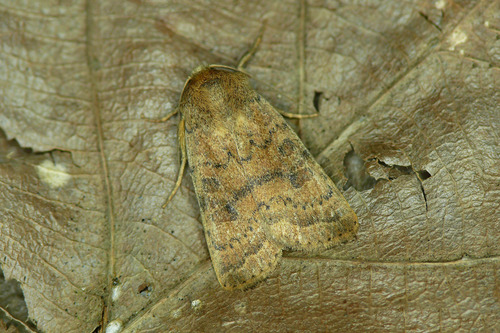
The Uncertain
Hoplodrina octogenaria
A master of summer camouflage, The Uncertain is a frequent visitor to backyard light traps. While its name suggests mystery, its subtle, golden-brown beauty is a highlight of the mid-summer night.
Quick Identification
Size
Wingspan of 28–34 mm (1.1–1.3 inches)
Colors
Forewings are ochreous-brown to grey-brown; hindwings are a uniform pale brownish-grey with darker veins.
Key Features
- Plain ochreous-brown forewings with a subtle glossy sheen
- Darker, faint kidney and oval-shaped markings (stigmata)
- Cross-lines are usually present but very fine and jagged
- Rests with wings folded flat over the body in a triangular shape
When You’ll See Them
Behavior
The Uncertain is a quintessentially nocturnal moth, emerging as the sun sets to seek out nectar sources and mates. Its name reflects a long-standing challenge for naturalists: it is notoriously difficult to distinguish from its close cousin, The Rustic. In the garden, you'll find them to be active fliers that are highly attracted to artificial light sources, often fluttering against windowpanes or circling porch lights during the height of summer.
During the daylight hours, this moth is a master of disguise. It tucks itself away in dense foliage, tall grass, or leaf litter where its earthy tones provide near-perfect camouflage against the soil and dried leaves. While they are solitary insects, it isn't uncommon to see several individuals congregating in the same area if there is a high-quality food source, such as a blooming butterfly bush or a patch of overripe fruit.
EverydayEarth exclusive
Camera Tips
To capture high-quality images of The Uncertain, your best bet is to set up your camera near a consistent light source. Since these moths are naturally drawn to UV spectrums, an LED 'moth light' or even a standard porch light with a white sheet draped behind it creates the perfect stage. Position your camera on a tripod approximately 12–18 inches from the sheet, using a macro lens setting if available to capture the subtle wing textures that help with identification.
If you prefer a more natural setup, 'sugaring' is an incredibly effective lure. Mix dark brown sugar, a bit of black treacle, and a splash of stale beer into a thick paste and paint it onto a fence post or tree trunk at chest height. Set your camera to trigger on movement or use a time-lapse mode (one shot every 30 seconds) starting an hour after sunset. The Uncertain is particularly fond of these fermented sweets and will often sit still for long periods while feeding, allowing for crisp, clear photos.
Because the markings on The Uncertain are quite subtle, lighting is everything. Avoid a direct, harsh front-flash which can 'blow out' the delicate brown scales and make the moth look like a featureless beige blob. Instead, try to position a secondary, dim light source at a 45-degree angle to create slight shadows, which will make the kidney-shaped stigmata on the wings more prominent. Peak activity occurs on warm, humid nights with heavy cloud cover—these are the nights you'll want your camera fully charged and ready.
Similar Species
Species that look similar or are commonly confused with The Uncertain.
Frequently Asked Questions
Record The Uncertain at your habitat
Connect a camera to start building your own species record — AI identifies every visitor automatically.