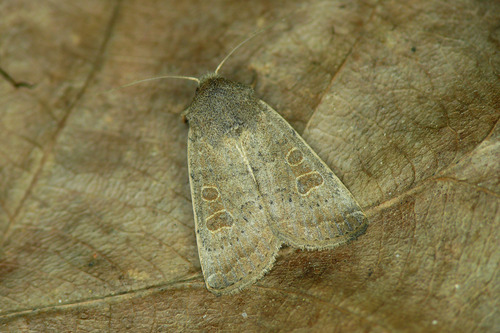
Vine's Rustic
Hoplodrina ambigua
A master of suburban camouflage, the Vine's Rustic is a common yet fascinating visitor to night-blooming gardens. While its colors are subtle, this hardy moth is a perfect subject for your backyard trail camera's infrared lens.
Quick Identification
Size
Wingspan of 30–34 mm (1.2–1.3 inches); body length approximately 15–18 mm (0.6–0.7 inches).
Colors
Forewings are typically a smooth, stony grey or pale sandy-buff. Features subtle darker outlines of kidney and circular spots. Hindwings are notably pale, almost translucent white with darker veins.
Key Features
- Smooth, silky greyish-brown forewings
- Distinctly pale, whitish hindwings
- Darker outlines on the orbicular and reniform spots
- Rests with wings held flat in a triangular shape
- Lacks the warmer reddish tones of similar species
When You’ll See Them
Behavior
The Vine's Rustic is a resilient and highly adaptable moth that has become a staple of the suburban garden. Unlike many of its more colorful relatives, it relies on its subtle, 'stony' appearance to remain camouflaged against rocks, walls, and dried leaves during the daylight hours. It is an opportunistic flier, often appearing in two distinct waves throughout the warmer months as successive generations emerge.
In the backyard ecosystem, these moths are essential pollinators for night-blooming flowers. While they are largely solitary, you may find several individuals congregating near a porch light or a particularly nectar-rich flowerbed. They are not known to be pests to humans, and their caterpillars feed harmlessly on common garden weeds rather than prized ornamental plants.
EverydayEarth exclusive
Camera Tips
To capture the Vine's Rustic on an AI-powered camera, placement is everything. These moths are strongly attracted to light, so mounting your camera near a white wall or a light-colored surface illuminated by a porch light is an easy win. For a more professional setup, try a dedicated moth light trap with the camera positioned at a macro-focus distance (usually 10-15cm if your camera supports it) to capture the delicate wing markings that distinguish it from other 'drab' moths.
The most effective 'lure' for this species is a sugary bait known as 'wine roping.' Soak a piece of thick natural rope in a fermented mixture of cheap red wine, sugar, and treacle, then drape it over a fence or branch within view of your camera. The Vine's Rustic has a keen sense of smell and will often land on the rope to feed, providing a perfectly still subject for a high-quality photo or video clip.
Because this species has two distinct flight periods, timing is crucial. Set your camera for 'high sensitivity' motion detection during the humid nights of late May or the cooling evenings of late August. Avoid windy nights, as moths tend to stay low in the herbage to avoid being blown off course. A calm, overcast night with a hint of moisture in the air is the 'golden hour' for moth activity.
For the best identification results, ensure your camera is set to capture images in infrared (IR) or use a gentle, diffused white light. The Vine's Rustic is best identified by the contrast between its grey forewings and its very pale hindwings. If your camera allows for video, a 5-second clip is often better than a still photo, as the way the moth vibrates its wings before take-off can help distinguish it from its cousins, the Uncertain and the Rustic.
Similar Species
Species that look similar or are commonly confused with Vine's Rustic.
Frequently Asked Questions
Record Vine's Rustic at your habitat
Connect a camera to start building your own species record — AI identifies every visitor automatically.