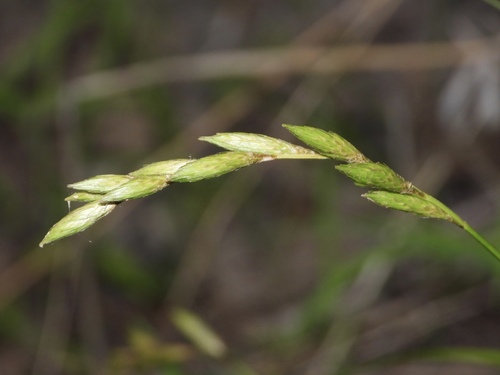
palm sedge
Carex muskingumensis
Transform your wet garden spaces into a tropical-looking haven with Palm Sedge. Its striking, symmetrical foliage provides the perfect 'stage' for capturing frogs, dragonflies, and hidden backyard wonders on camera.
Quick Identification
Size
Height: 24–36 inches (60–90 cm); Spread: 18–24 inches (45–60 cm)
Colors
Bright lime-green to emerald foliage; small, pointed brown flower spikes (seed heads) appearing in mid-summer
Key Features
- Unique 'palm frond' leaf arrangement along the stems
- Narrow, pointed leaves up to 8 inches long
- Clump-forming habit with three-angled stems
- Distinctive copper-colored seed heads in late summer
When You’ll See Them
Behavior
Unlike many garden plants that demand constant attention, Palm Sedge is a hardy, conservative species that thrives in the quiet, damp corners of the landscape. It grows in dense, attractive clumps, spreading slowly via short rhizomes to create a lush, tropical-looking groundcover. In the wild, it is often a sign of a high-quality, intact ecosystem, as it prefers areas where native vegetation hasn't been disturbed.
For the backyard observer, Palm Sedge acts as a miniature skyscraper for the local insect population. Its structured leaves provide essential climbing platforms for dragonflies and damselflies, while the dense base offers a cool, humid microclimate for frogs and salamanders during the heat of the day. While it doesn't 'behave' in the animal sense, its presence fundamentally changes the social dynamics of your backyard, drawing in moisture-loving species that might otherwise bypass your garden.
EverydayEarth exclusive
Camera Tips
To capture the true beauty of Palm Sedge, position your camera at a low 'worm's-eye view' (about 6-12 inches off the ground). This angle highlights the unique palm-like symmetry of the leaves and allows you to catch the small inhabitants—like tree frogs or beetles—that use the foliage as a highway. If your camera has a macro or close-focus setting, aim it at the stem junctions where moisture collects, as this is a prime spot for activity.
Time-lapse photography is particularly rewarding with this species. Set your camera to take one photo every hour during the spring growth spurt (April and May). You will see the stems 'telescope' upward with surprising speed. During the summer, a faster time-lapse (one photo every 5-10 minutes) on a breezy day creates a beautiful 'waving' effect that showcases the plant's structural flexibility.
Because Palm Sedge loves wet environments, look for the 'golden hour' light—the hour after sunrise or before sunset. The long, narrow leaves capture backlighting beautifully, making the plant appear to glow from within. This is also the best time to catch dragonflies perching on the tips of the leaves to warm their wings. Ensure your camera is equipped with a high-speed SD card if you are using motion-triggering, as the wind moving the leaves can create many 'false' triggers; use a medium sensitivity setting to avoid filling your card with empty shots.
In the autumn, don't move your camera! As the plant turns from green to a rich tawny gold, it provides excellent contrast for winter birds like sparrows and juncos who come to forage for seeds in the dried flower spikes. Keep your camera active through the first snow to capture the architectural 'sculpture' the dried stems create against the white background.
Similar Species
Species that look similar or are commonly confused with palm sedge.
Frequently Asked Questions
Record palm sedge at your habitat
Connect a camera to start building your own species record — AI identifies every visitor automatically.