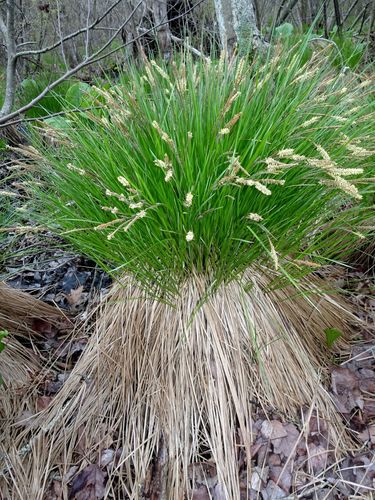
tussock sedge
Carex stricta
The structural cornerstone of the American wetland, Tussock Sedge creates living islands that provide vital sanctuary for wildlife. Its unique mounded form and year-round presence make it a fascinating subject for any backyard habitat observer.
Quick Identification
Size
1–3 feet (30–90 cm) tall and wide; forms dense, elevated mounds that can persist for decades.
Colors
Bright to medium green foliage; dark brown to tan seed spikes; reddish-brown or purple-tinted basal sheaths.
Key Features
- Distinctive 'tussock' or hummock shape formed by accumulated dead leaves
- Stiff, triangular stems characteristic of the sedge family
- Upright, narrow blades that arch gracefully as they mature
- Deeply textured, 'netted' fibers at the base of the stems
When You’ll See Them
Behavior
Tussock sedge is a structural architect of North American wetlands. Unlike many grass-like plants that spread evenly across a meadow, this species grows in dense, concentrated clumps. Over time, as the older leaves die back, they accumulate at the base of the living plant, creating an elevated 'hummock' or island. These islands can stand several inches above the water level, providing dry ground for wildlife in otherwise flooded environments.
This plant is primarily colonial, often growing in vast stands called 'sedge meadows.' While it remains stationary, it undergoes a dramatic seasonal transformation. In early spring, it is among the first to send up bright neon-green shoots, followed by the appearance of dark, caterpillar-like flowering spikes. By winter, the foliage turns a warm straw-color, maintaining its mounded shape and providing architectural interest and cover even under the snow.
EverydayEarth exclusive
Camera Tips
Capturing the essence of tussock sedge requires a shift in how you use your trail camera. Because these plants form elevated 'islands,' they are magnets for wetland wildlife. Position your camera at a low angle, roughly 6 to 12 inches above the ground, and aim it directly at the crown of a well-established hummock. You are likely to capture frogs, turtles, and even small mammals like meadow voles using the tussock as a dry lookout point or a resting spot above the water line.
To highlight the plant's unique texture and movement, use the 'Time Lapse' setting. Setting your camera to take a photo every 15-30 minutes during the spring (late April to June) will create a stunning visual record of the 'green-up' phase, where the bright new growth erupts from the brown winter base. For still photography, prioritize the 'Golden Hour'—the hour after sunrise or before sunset. The side-lighting will catch the fine edges of the sedge blades and the delicate fibers of the flowering spikes, making the plant stand out against the background.
Because tussock sedge thrives in wet areas, equipment protection is vital. Use a high-quality waterproof camera housing and a sturdy mounting stake that can be driven deep into the soft mud to prevent the camera from leaning. If you are interested in the insect life the plant supports, such as the Eyed Brown butterfly, set your camera to a high-trigger speed or video mode. These insects often use the tall blades as perches, and a 10-second video clip can capture the micro-movements of the wetland ecosystem that photos might miss.
In the winter, don't pack your camera away. Tussock sedge hummocks are often the only visible features in a frozen marsh. Placing a camera near a stand of sedge during a snowstorm can yield beautiful footage of birds like Swamp Sparrows seeking shelter within the dense, dry foliage. Ensure your batteries are cold-weather rated (lithium) for these winter sessions, as the straw-colored mounds are excellent subjects for high-contrast winter photography.
Similar Species
Species that look similar or are commonly confused with tussock sedge.
Frequently Asked Questions
Record tussock sedge at your habitat
Connect a camera to start building your own species record — AI identifies every visitor automatically.