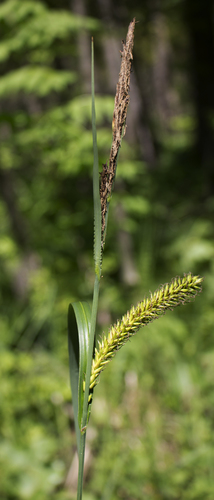
lake sedge
Carex lacustris
A titan of the marshlands, lake sedge transforms soggy shorelines into vibrant, waving meadows. Its distinctive purple-hued bases and towering height make it the perfect skyscraper for backyard wetland wildlife.
Quick Identification
Size
Stands 50–150 cm (1.6–4.9 ft) tall with leaves up to 1.5 cm (0.6 in) wide
Colors
Deep bluish-green foliage with distinctive reddish-purple or 'wine-colored' leaf sheaths at the base
Key Features
- Robust, three-sided stems typical of sedges
- Vivid reddish-purple tinting at the base of the plant
- Fine cross-veins between the main leaf veins create a ladder-like texture
- Large, spike-like flowering structures
When You’ll See Them
Behavior
Lake sedge is a foundational wetland plant that spreads primarily through an extensive network of underground rhizomes. This allows it to form dense, monocultural stands known as sedge meadows. These thickets provide essential cover for various wildlife, from nesting waterfowl to small mammals hiding from predators. Unlike many garden grasses, lake sedge is a "true sedge," meaning it thrives in saturated soils and can even grow in standing water up to 1.6 feet deep.
As a wind-pollinated species, it doesn't rely on flashy flowers to attract insects, but its architectural presence is unmistakable in the northern landscape. During the spring and summer, it grows rapidly, reaching eye-level for many humans. In the autumn, the plant turns a golden-tan color, and though it goes dormant in winter, its sturdy stalks often remain standing above the snow, providing a windbreak for overwintering creatures.
EverydayEarth exclusive
Camera Tips
To capture the beauty of lake sedge and the animals it attracts, place your camera on a sturdy stake or mount about 2 to 3 feet off the ground. Because sedges grow in soft, mucky soil, a standard tripod might sink or tilt over time; a T-post or a long wooden stake driven deep into the substrate provides a more stable platform. Aim the lens slightly downward to capture the play of light on the broad leaves, or set it at a low angle to glimpse the secretive birds like rails or herons that move through the stalks.
Lighting is your best friend with this species. The long, linear leaves of lake sedge catch the 'golden hour' light beautifully. Position your camera facing east or west to take advantage of backlighting during sunrise or sunset, which will highlight the fine textures and the reddish-purple bases of the stems. If you are using an AI-powered camera, the movement of the sedge in the wind can sometimes trigger false positives. To mitigate this, try to frame your shot with a clear opening in the foreground or adjust the sensitivity settings to focus on larger heat signatures like ducks or muskrats.
Don't just focus on the plant itself—use it as a natural blind. If you have a backyard pond or a wet ditch where lake sedge grows, place the camera at the edge of the patch. The dense cover of the sedge is a magnet for wildlife. You don't need bait; the habitat itself is the lure. In late spring, look for the spikes of the flowers, and in winter, keep the camera rolling to see how small mammals use the dried 'tents' of collapsed sedge for thermal cover. A time-lapse setting is also highly effective for lake sedge, allowing you to see the dramatic transition from the first green shoots of April to the towering amber waves of October.
Similar Species
Species that look similar or are commonly confused with lake sedge.
Frequently Asked Questions
Record lake sedge at your habitat
Connect a camera to start building your own species record — AI identifies every visitor automatically.