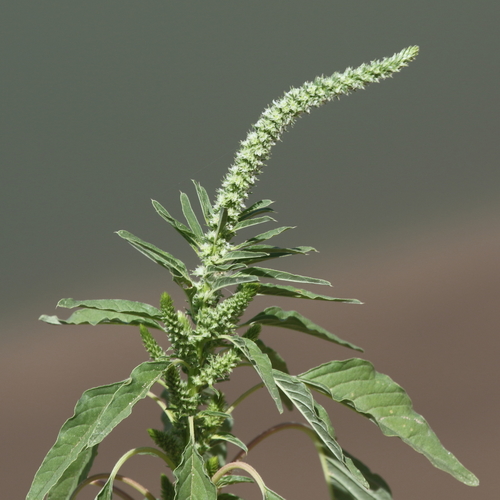
Palmer's Amaranth
Amaranthus palmeri
A champion of resilience and rapid growth, Palmer's Amaranth is a fascinating look at nature's ability to thrive in any environment. Known for its 'sun-tracking' leaves and towering spikes, it is a master of the backyard landscape.
Quick Identification
Size
Height: 1-3 meters (3-10 feet); Leaf length: 5-20 cm (2-8 inches)
Colors
Bright green to yellowish-green foliage, frequently featuring reddish or purple stems; some leaves display a faint white or silver chevron or 'V' watermark
Key Features
- Petioles (leaf stems) are consistently longer than the leaf blades themselves
- Diamond-shaped or ovate leaves with prominent veins
- Terminal flower spikes can reach up to 18 inches in length
- Pointed, prickly bracts on female seed heads
- Smooth, reddish-tinted stems
When You’ll See Them
Behavior
Palmer's Amaranth is an exceptionally aggressive annual plant known for its rapid growth and high reproductive capacity. Unlike many other weeds, it is dioecious, meaning individual plants are either male or female. This requires wind-driven cross-pollination to produce seeds, a process that ensures high genetic diversity and has helped the species develop resistance to many common herbicides.
In a backyard setting, this plant acts as a pioneer species, quickly colonizing disturbed soil or garden beds. It is known for its heliotropic behavior, where the leaves actually move throughout the day to track the sun, maximizing its photosynthetic efficiency. While it is considered a problematic weed in agriculture, it has historical significance as a food source, with its seeds and young leaves being edible and highly nutritious.
EverydayEarth exclusive
Camera Tips
Capturing the perfect shot of Palmer's Amaranth requires focusing on its unique structural proportions. To distinguish it from other 'pigweeds,' position your AI-powered camera at a side-angle relative to the leaves. The key identifier is the petiole (the small stalk connecting the leaf to the stem). If you fold the leaf back over the stalk and the stalk is longer than the leaf, you’ve likely found Palmer's Amaranth. Use a macro lens or a close-up setting to highlight this feature clearly for the AI's identification algorithms.
For time-lapse enthusiasts, this species is a goldmine. Because it can grow up to 2-3 inches per day in peak summer heat, a 48-hour time-lapse sequence can dramatically show the plant's vertical progression. Place your camera on a sturdy tripod about 3-4 feet away from a young specimen, ensuring the frame includes a fixed reference point like a fence post or a garden stake to emphasize the growth rate.
Lighting is crucial for revealing the 'V' watermark often found on the foliage. Early morning or 'golden hour' light provides a soft, directional glow that emphasizes the texture of the leaves and the reddish hues of the stems. If you are documenting the flowering stage, be aware that female plants have much pricklier seed heads than males. A high-angle top-down shot of the terminal spike will help document these sharp bracts, which are a definitive botanical marker for the species.
Similar Species
Species that look similar or are commonly confused with Palmer's Amaranth.
Frequently Asked Questions
Record Palmer's Amaranth at your habitat
Connect a camera to start building your own species record — AI identifies every visitor automatically.