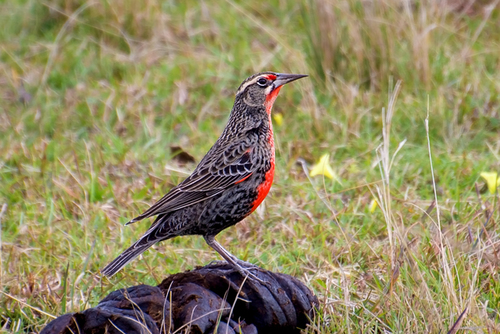
Pampas Meadowlark
Leistes defilippii
The scarlet-breasted jewel of the South American plains, the Pampas Meadowlark is a symbol of the wild, untouched grasslands. Witness its soaring song flights and vibrant colors through the lens of your trail camera.
Quick Identification
Size
Length: 21 cm (8.3 in); Weight: 65-70 g (2.3-2.5 oz)
Colors
Upperparts are dark brownish-black with heavy streaking; breast and throat are a brilliant, solid scarlet-red; underwings are distinctive charcoal black; males are more vibrantly colored than females.
Key Features
- Solid scarlet-red throat and breast
- Jet black underwing feathers visible in flight
- Strong, pointed bill for probing soil
- Prominent white 'eyebrow' stripe (supercilium)
When You’ll See Them
Behavior
Unlike many other birds in the Icteridae family, the Pampas Meadowlark is a true grassland obligate, meaning it relies entirely on native, undisturbed plains. They are relatively shy birds that will quickly duck into tall grass if they feel threatened, making them a rewarding challenge for wildlife observers to spot.
EverydayEarth exclusive
Camera Tips
To capture the perfect shot of a Pampas Meadowlark, your camera should be positioned low to the ground. These birds spend the majority of their time foraging on the floor of the pampas, so a camera height of 12 to 24 inches is ideal. Angle the lens slightly upward to emphasize the brilliant red of their breast. Look for natural clearings in the grass or the edges of cattle paths where they often land before moving into denser cover.
Strategic placement near perches is the secret to high-quality images. While they are ground birds, males frequently use fence posts, old wooden stakes, or the tops of tall thistles as 'song posts' to survey their territory. If your backyard or trail area has a fence line, mounting a camera directly to a post or using a tripod nearby will likely yield frequent captures. Aim your camera toward the south to ensure the morning and afternoon sun illuminates the red plumage without creating harsh silhouettes.
Since the Pampas Meadowlark is wary of human activity, use a camera with a high-speed trigger and a 'silent shutter' mode if available. If you are using a lure, avoid traditional bird feeders; instead, a shallow, ground-level water basin or a 'drip' feature can be incredibly effective in dry grassland environments. Setting your camera to 'Burst Mode' (3-5 photos per trigger) is highly recommended, as it increases your chances of capturing their distinctive black underwings during the moment of takeoff.
Similar Species
Species that look similar or are commonly confused with Pampas Meadowlark.
Frequently Asked Questions
Record Pampas Meadowlark at your habitat
Connect a camera to start building your own species record — AI identifies every visitor automatically.