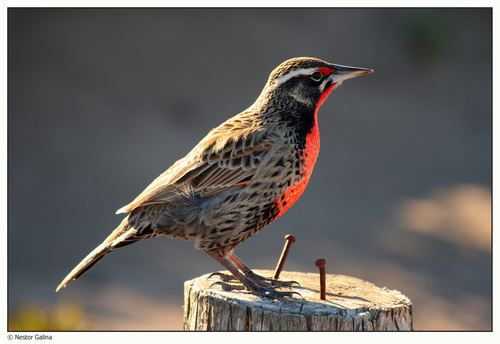
Long-tailed Meadowlark
Leistes loyca
Boasting a brilliant scarlet breast and a flute-like song, the Long-tailed Meadowlark is a vibrant highlight of the Patagonian landscape. Often seen atop fence posts or foraging in open meadows, this striking bird is a favorite for backyard observers across southern South America.
Quick Identification
Size
Length of 25–28 cm (9.8–11 in); wingspan approx. 38–42 cm (15–16.5 in); weight 80–115 g (2.8–4 oz).
Colors
Striking scarlet-red breast and throat in males; brownish-black upperparts with heavy streaking; distinctive white and yellow supercilium with a red spot in front of the eye. Females are paler with pinkish-red tints.
Key Features
- Vivid scarlet-red breast and throat (males)
- Long, pointed bill and notably long tail compared to other meadowlarks
- White eyebrow stripe with a distinct red 'loral' spot
- Streaked brown and black back for camouflage
When You’ll See Them
Geographic range
Where Does the Long-tailed Meadowlark Live?
The Long-tailed Meadowlark is a quintessential species of the southern cone of South America. It is native to the vast landscapes of Chile and Argentina, ranging from the central provinces all the way south to the rugged tip of Tierra del Fuego. Beyond the mainland, it is one of the most common and iconic birds of the Falkland Islands, where it is often found among the coastal tussac grass.
Basemap © OpenStreetMap contributors
Behavior
Long-tailed Meadowlarks are primarily terrestrial birds, spending much of their day walking or running through short grass in search of food. They move with a confident, jerky gait, frequently pausing to probe the soil with their long, sharp bills. During the breeding season, males become highly conspicuous, choosing the highest available perches—such as fence posts, large rocks, or the tops of bushes—to deliver their loud, flute-like songs and defend their territory.
These birds are generally social and can be found in pairs or small family groups during the spring. In the winter months, they often gather into larger, loose flocks to forage across agricultural fields and open plains. While they are wary of sudden movements, they are quite comfortable living alongside humans in rural and suburban settings, often visiting large gardens or farmyards that offer open ground and scattered cover.
EverydayEarth exclusive
Camera Tips
To successfully capture the Long-tailed Meadowlark on your trail camera, you must focus on their ground-dwelling nature. Place your camera at a very low height, roughly 12 to 18 inches off the ground, and angle it slightly upward across a patch of short-cropped grass or a dirt clearing. Because these birds prefer to walk rather than hop, a low-angle setup provides an intimate, eye-level perspective that highlights their brilliant red plumage and avoids the 'top-down' look that hides their features.
If your backyard has fence posts, stone walls, or lone shrubs, these are prime real estate for a camera. Males frequently return to the same 'singing post' multiple times an hour during the spring. Mounting a camera 3–5 feet away from a known perch will allow you to capture stunning portraits and videos of their vocal displays. In more open areas, you can encourage them to visit a specific spot by offering a ground-level feeding tray filled with mealworms or a high-energy seed mix containing cracked corn and sunflower hearts.
Lighting is crucial for this species; their red breast feathers can easily 'wash out' or look dark depending on the sun. Position your camera facing North (in the Southern Hemisphere) to ensure even, front-lit subjects during the peak morning and afternoon hours. For the best results, use a fast trigger speed and set your camera to 'Burst Mode'—this helps capture the perfect frame as they move their heads quickly while searching for insects or reacting to nearby sounds.
Similar Species
Species that look similar or are commonly confused with Long-tailed Meadowlark.
Frequently Asked Questions
Record Long-tailed Meadowlark at your habitat
Connect a camera to start building your own species record — AI identifies every visitor automatically.