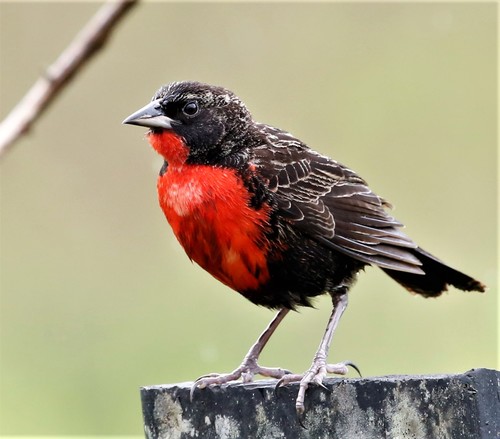
Red-breasted Meadowlark
Leistes militaris
With his jet-black feathers and a chest that glows like a ruby, the Red-breasted Meadowlark is a crown jewel of the open grasslands. This striking songbird brings a flash of brilliant color to pastures and fields throughout the tropics.
Quick Identification
Size
Length: 19 cm (7.5 in); Weight: 40–48 g (1.4–1.7 oz)
Colors
Males feature jet-black plumage with a brilliant scarlet-red throat and breast; females are cryptic buff-brown with heavy dark streaking.
Key Features
- Striking scarlet-red throat and breast on males
- Short, pointed bill typical of meadowlarks
- Short tail and broad wings
- Cryptic, streaked brown plumage on females and juveniles
When You’ll See Them
Behavior
The Red-breasted Meadowlark is a bird of open spaces, often found in wet pastures, rice fields, and grassy savannahs. Unlike many other members of the blackbird family, they are quite terrestrial, spending a significant portion of their day walking along the ground in search of food. They are known for their distinctive song—a series of wheezing whistles—usually delivered from a prominent perch like a fence post or a tall weed.
During the breeding season, males become highly territorial and perform impressive aerial displays, flying upward and then gliding back down to their perch while singing. While they are generally tolerant of human presence in agricultural areas, they remain wary and will crouch low in the grass to avoid detection if they feel threatened. Outside of the breeding season, they may form small, loose flocks to forage.
EverydayEarth exclusive
Camera Tips
To capture the Red-breasted Meadowlark, focus your camera on low-profile perches rather than high trees. These birds love to survey their territory from fence posts, barbed wire, or sturdy stalks of grass about 3 to 5 feet off the ground. Position your camera about 10-15 feet away from a known 'singing post' for the best results. A side-on angle is preferable to capture the brilliant contrast between the male's black back and red breast.
Because they are ground foragers, placing a camera near a localized patch of short grass adjacent to taller cover can yield great action shots of them hunting insects. Use a fast shutter speed or a high-frame-rate video setting (at least 60fps) if your camera allows, as their movements while foraging and their flight displays are quite rapid. Set the trigger sensitivity to high, as these are relatively small birds that move quickly.
If you are trying to attract them to a specific spot for a backyard camera setup, they are less likely to visit traditional hanging feeders. Instead, provide a ground-level bird bath or a low platform feeder stocked with high-quality birdseed or mealworms. They are particularly drawn to water sources in drier pastures. Ensure the area around the camera is clear of swaying tall grass that might cause false triggers on windy days.
Lighting is crucial for this species; the scarlet red can easily 'blow out' in harsh midday sun, and the black plumage can lose detail. Early morning light (the golden hour) provides the best color saturation and shows off the iridescence in the male's black feathers. In rainy seasons, look for them after a downpour when insects are active and the birds are out preening.
Similar Species
Species that look similar or are commonly confused with Red-breasted Meadowlark.
Frequently Asked Questions
Record Red-breasted Meadowlark at your habitat
Connect a camera to start building your own species record — AI identifies every visitor automatically.