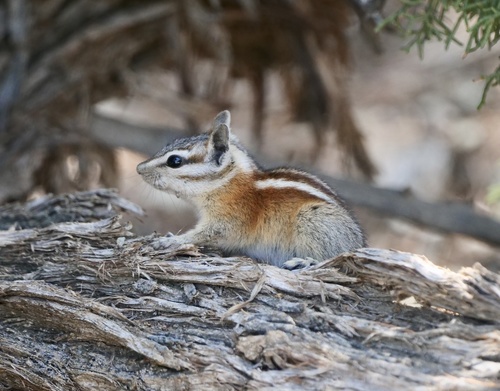
Panamint Chipmunk
Neotamias panamintinus
A vibrant specialist of the high desert, the Panamint Chipmunk thrives among the rugged pinyon-juniper slopes of the California-Nevada border. With its striking cinnamon-colored sides and incredible climbing skills, it is a master of survival in the arid 'sky islands' of the Southwest.
Quick Identification
Size
Total length 8-9 inches (20-23 cm); weight 1.2-1.8 oz (35-50 g)
Colors
Tawny or reddish-orange sides with a distinct gray rump; five dark dorsal stripes separated by white or light gray
Key Features
- Bright reddish-cinnamon flanks
- Distinct grayish-white rump
- Three dark and two light facial stripes
- Compact, agile build for rock climbing
When You’ll See Them
Geographic range
Where Does the Panamint Chipmunk Live?
Native to the North American continent, the Panamint Chipmunk is a true specialist of the Southwestern United States. Its core range is remarkably localized, spanning the desert mountain ranges of southeastern California and southwestern Nevada, including the Panamint, Inyo, and White Mountains. Because they are restricted to these specific 'sky islands' of habitat surrounded by lower desert basins, they do not have introduced populations elsewhere.
Basemap © OpenStreetMap contributors
Behavior
The Panamint Chipmunk is a diurnal dynamo, most active during the cooler hours of the morning and late afternoon. Unlike many of its cousins that prefer lush forests, this species is a specialist of the arid, rocky slopes, where it displays incredible agility jumping between granite boulders and navigating pinyon-juniper branches. They are solitary creatures but highly vocal, often using sharp 'chipping' calls to alert others of potential predators like hawks or snakes.
These chipmunks are meticulous gatherers, spending much of the late summer and autumn filling their internal cheek pouches with seeds to stockpile in underground burrows or rocky crevices. While they do hibernate during the coldest winter months, they are known to wake up periodically to snack on their caches. In areas near hiking trails or remote mountain homes, they can become quite bold, though they generally maintain a cautious distance from humans.
EverydayEarth exclusive
Camera Tips
To capture the Panamint Chipmunk on camera, focus your efforts on 'edge' habitats where pinyon-juniper trees meet large rock formations. These chipmunks love to use flat-topped boulders as lookout posts or 'shelling stations' where they eat their seeds. Position your camera about 6 to 12 inches off the ground, aimed across the top of a flat rock or toward the base of a pinyon tree where you see piles of discarded pine cone scales.
Since these rodents are relatively small, use a camera with a fast trigger speed and a short focal distance if possible. They move in quick, jerky bursts, so a high-speed video mode or a multi-shot burst setting is essential to catch them in focus. Setting the camera to record during the early morning hours will yield the best natural lighting and catch their peak activity period just after sunrise.
While we don't recommend feeding wildlife, you can naturally attract them to a camera site by placing it near a water source or a particularly productive pinyon pine during the fall harvest. Ensure your camera is well-secured, as these curious climbers may occasionally inspect the device, and avoid placing it in direct midday sun, which can wash out the colors of their vibrant reddish flanks and cause the PIR sensor to misfire in the desert heat.
Similar Species
Species that look similar or are commonly confused with Panamint Chipmunk.
Frequently Asked Questions
Record Panamint Chipmunk at your habitat
Connect a camera to start building your own species record — AI identifies every visitor automatically.