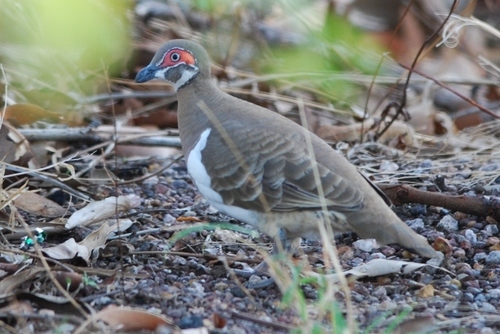
Partridge Pigeon
Geophaps smithii
A master of ground-level camouflage, the Partridge Pigeon is one of Northern Australia's most unique avian residents. With its striking eye patches and partridge-like gait, it brings a touch of the outback's hidden character to any trail camera.
Quick Identification
Size
Length: 25–28 cm (10–11 inches); Weight: 175–220 g (6.2–7.8 oz)
Colors
Dull olive-brown upperparts and a grayish-pink breast. Most notable for a large patch of bare skin around the eye (red in the Northern Territory, yellow in the Kimberley) and white-tipped tail feathers.
Key Features
- Large red or yellow bare skin patch around the eye
- Stout, partridge-like body shape
- White-to-grayish breast with fine black barring
- Ground-dwelling posture with a low, bobbing walk
When You’ll See Them
Behavior
The Partridge Pigeon is a highly specialized ground-dwelling bird that behaves more like a quail or a partridge than a typical pigeon. They are rarely seen high in trees, preferring to forage, socialise, and even nest on the forest floor. When approached, they rely on their excellent camouflage, often remaining motionless until the last possible second before flushing with a loud, frantic clapping of wings.
These pigeons are usually seen in pairs or small family groups. They have a very distinctive way of moving, often running with a low, crouched profile and occasionally pausing to bob their heads. They are quite habitual, following the same tracks to water sources each morning and afternoon, which makes them excellent subjects for trail camera observation once their paths are identified.
EverydayEarth exclusive
Camera Tips
To successfully capture the Partridge Pigeon on camera, you must think at ground level. These birds spend 95% of their lives on the forest floor, so your camera should be mounted no higher than 15–25 centimeters (6-10 inches) off the ground. Aiming the camera along a known game trail or a clearing near a waterhole is the most effective strategy. Using a small stake or a low-profile rock mount is often better than a tree strap to get the right angle.
Because they inhabit the tropical north, lighting can be extremely harsh during the day. Position your camera facing south or north to avoid direct sun flare on their white breast feathers, which can wash out the image. If you are using a camera with video capability, set it to record at least 20-second clips; these birds often move slowly and cautiously, and a short 5-second clip might miss the social interactions or the characteristic head-bobbing that makes them so interesting to watch.
During the dry season, water is the ultimate lure. A shallow ground-level birdbath or even a small depression in the dirt kept moist will attract every Partridge Pigeon in the vicinity. They are creatures of habit and will often visit the same water source at almost the exact same time every afternoon. If your camera has a 'time-lapse' mode, consider using it during the late afternoon (4 PM to sunset) to capture their arrival without needing to rely solely on the PIR motion sensor, which can sometimes be tricked by moving grass in the wind.
Similar Species
Species that look similar or are commonly confused with Partridge Pigeon.
Frequently Asked Questions
Record Partridge Pigeon at your habitat
Connect a camera to start building your own species record — AI identifies every visitor automatically.