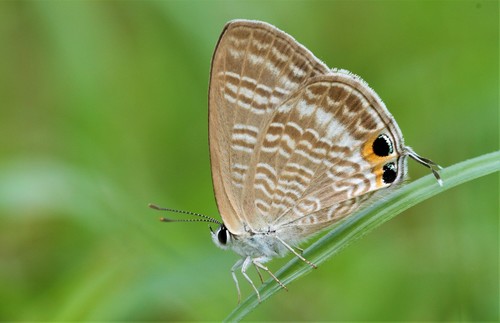
Pea Blue
Lampides boeticus
A master of disguise and a world-class traveler, the Pea Blue butterfly brings a shimmer of violet to any backyard garden. Watch for its clever 'false head' trick, a brilliant evolutionary strategy used to outsmart hungry predators.
Quick Identification
Size
Wingspan of 24–34 mm (0.9–1.3 inches)
Colors
Males feature iridescent violet-blue uppersides with thin dark borders; females are primarily brown with blue dusting near the body. Both have sandy-brown undersides with white wavy lines and two black spots near the tail.
Key Features
- Slender, hair-like tails on the hindwings
- Two prominent black eyespots at the base of the tails
- Intricate white wavy 'marbled' pattern on the sandy underside
- Fast, erratic flight pattern
When You’ll See Them
Behavior
The Pea Blue is a remarkably energetic and wide-ranging traveler, known for its strong migratory capabilities. Unlike many small butterflies that stay confined to a small territory, these butterflies can travel vast distances across continents in search of fresh breeding grounds. They are often seen fluttering rapidly among low-growing vegetation, rarely staying still for long unless they are nectaring or egg-laying on a host plant.
One of their most fascinating behaviors is the use of 'decoy' anatomy. When perched, the Pea Blue often rubs its hindwings together, causing the small tails to wiggle like antennae. This, combined with the dark eyespots near the tail, creates a 'false head.' Predators like birds or spiders are often tricked into attacking the expendable wing tips rather than the butterfly’s actual head, allowing the Pea Blue to escape with only minor wing damage.
EverydayEarth exclusive
Camera Tips
Capturing high-quality images of a Pea Blue requires focusing your camera on their favorite 'refueling stations.' Because these butterflies are small and move quickly, the best strategy is to position your AI-powered camera 12 to 18 inches away from nectar-rich flowers like lavender, verbena, or buddleia. If you have a vegetable garden with peas or beans, placing a camera near the flowering tops of these plants is a guaranteed way to see them, as females will visit frequently to lay eggs.
To get the best identification shots, try to set your camera at a side-on angle rather than looking down from above. The most distinctive features of the Pea Blue—the wavy 'marbled' underside and the delicate tails—are best viewed from the side when the butterfly has its wings closed. Ensure the area is in full sun; these butterflies are most active when it is hot and bright, and the sunlight will make the male's violet-blue upperside pop if you happen to catch them with their wings open.
Because they are erratic fliers, set your camera to its highest motion sensitivity and use the 'burst' mode or high-frame-rate video if available. A slow trigger speed will often result in a photo of a flower just after the butterfly has flitted away. If you are using a trail camera, look for one with a macro or close-focus lens, as standard trail cams often have a minimum focus distance of 3-5 feet, which is too far for a butterfly of this size.
Similar Species
Species that look similar or are commonly confused with Pea Blue.
Frequently Asked Questions
Record Pea Blue at your habitat
Connect a camera to start building your own species record — AI identifies every visitor automatically.