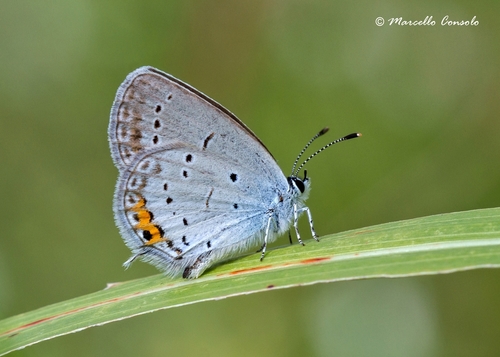
Short-tailed Blue
Cupido argiades
A tiny, violet-hued gem of the grassy meadows, the Short-tailed Blue is famous for its delicate 'cupid' tails and low-flying grace. This resilient little butterfly turns any backyard clover patch into a theater of iridescent beauty.
Quick Identification
Size
Wingspan of 22–30 mm (0.85–1.2 inches)
Colors
Males are violet-blue with thin black borders; females are dusky brown with a blue dusting at the wing base. Both have pale grey undersides.
Key Features
- Tiny, thread-like 'tails' on the hindwings
- Two distinct orange spots at the base of the tail on the underside
- Small black spots on a pale grey-white underside
- Low, fluttering flight pattern near the ground
When You’ll See Them
Behavior
The Short-tailed Blue is a low-altitude specialist, rarely rising more than a few feet above the grass. They spend the majority of their day fluttering between nectar sources or searching for host plants. They are particularly known for a behavior called 'puddling,' where males gather on damp soil or mud to drink mineral-rich water, which helps increase their reproductive success.
These butterflies are relatively sedentary compared to larger species, often spending their entire life cycle within a small meadow or garden patch. When they aren't feeding, they can be seen 'basking' on leaves with their wings spread at a 45-degree angle to soak up the sun's warmth. They are social in a loose sense, often seen in the company of other 'Blue' butterfly species around flowering clover.
EverydayEarth exclusive
Camera Tips
Capturing the Short-tailed Blue requires a macro-focused approach. Because these butterflies rarely fly higher than knee-level, you should set your camera on a low tripod or even a ground spike, aiming at a height of 6 to 12 inches. Focus your lens on a specific cluster of flowering white clover or bird's-foot trefoil, as these are their preferred 'landing pads.' If your camera has a manual focus or focus-peaking feature, set it to the front edge of the flowers to catch the butterfly as it lands.
To encourage them to stay in front of your lens, you can create a 'puddling station.' Simply keep a small patch of soil or sand damp with a mixture of water and a tiny pinch of sea salt. Place your camera overlooking this damp spot in full sunlight. This is one of the few ways to get a perfectly still shot of the male's vibrant violet-blue upperside, as they often hold their wings open while drinking minerals.
Lighting is your best friend with this species. The early morning (between 8 AM and 9:30 AM) is the best time for high-detail photography. During this window, the butterflies are often sluggish and will bask on flat leaves to warm up. Their wings stay open longer, and the soft, angled morning light highlights the iridescent scales of the males and the delicate 'tail' structures that are easily lost in the harsh midday sun.
For trail camera users, a time-lapse mode is more effective than a motion trigger for insects this small. Set your camera to take a photo every 5 to 10 seconds during peak sunny hours. Use a fast shutter speed (1/500s or higher) to freeze the motion of their wings. Because they are so small, ensure your camera is positioned within 12-18 inches of the target flower patch to fill the frame sufficiently.
Similar Species
Species that look similar or are commonly confused with Short-tailed Blue.
Common Blue
Lacks the thread-like tails and has a more extensive row of orange spots along the wing edges.
Holly Blue
Found higher up in shrubs/trees; lacks tails and has a pale blue underside with tiny black dots but no orange.
Small Blue
Much smaller and darker (almost black) with a silvery-grey underside and no orange spots or tails.
Frequently Asked Questions
Record Short-tailed Blue at your habitat
Connect a camera to start building your own species record — AI identifies every visitor automatically.