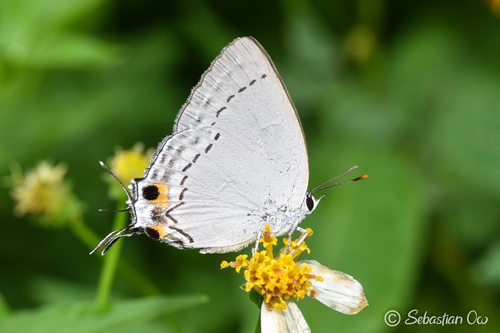
Peacock Royal
Tajuria cippus
A master of deception and a flash of cerulean beauty, the Peacock Royal is one of the most stunning butterflies you can find in an urban garden. With its elegant tails and shimmering wings, it brings a touch of tropical royalty to any backyard camera feed.
Quick Identification
Size
Wingspan of 30–45 mm (1.2–1.8 inches)
Colors
Males feature brilliant peacock-blue upper wings with black borders; females are a duller, grayish-blue. Both sexes have light greyish-white undersides with thin black bands and orange-ringed black spots near the tails.
Key Features
- Two long, white-tipped filamentous tails on each hindwing
- Brilliant iridescent peacock-blue upper side (males)
- Orange-ringed black 'eye-spots' at the base of the tails
- Thin, wavy black line across a greyish-white underside
When You’ll See Them
Behavior
The Peacock Royal is an energetic and fast-flying butterfly, often seen darting through the canopy or descending to garden shrubs. Males are highly territorial and engage in 'hilltopping,' where they occupy high perches on trees or hills to monitor for mates and chase off rival insects with surprising speed.
One of their most fascinating behaviors is the use of 'false head' mimicry. When perched, the Peacock Royal frequently twitches its hindwings, causing the long tails to move like antennae. This draws a predator's attention away from its actual head and toward the expendable wing-tips, allowing the butterfly to escape with only a small notch missing from its wing if attacked.
EverydayEarth exclusive
Camera Tips
To capture the Peacock Royal on an AI-powered backyard camera, strategy is key. These butterflies are rarely ground-dwellers; instead, they frequent the mid-to-high canopy. If you have a tree in your yard hosted by parasitic mistletoe, mount your camera 5 to 10 feet high, angled toward the outer branches where the mistletoe grows. This is where females will be laying eggs and where much of the activity occurs.
For ground-level shots, focus your camera on 'nectar magnets' such as Lantana or Poinsettia. Because the Peacock Royal is a fast flyer, you will need a camera with a high-speed trigger and a macro or short-focus lens. Set your device to capture high-resolution bursts or short 4K video clips. The fine details—like the thin black lines on the underside and the delicate white-tipped tails—are essential for a successful AI identification and are best captured when the butterfly is momentarily still while feeding.
Lighting can make or break your photo. The iridescent blue scales on the male’s wings only 'pop' when hit by direct sunlight. Position your camera so it is south-facing (if in the northern hemisphere) to ensure the subjects are front-lit during the peak activity hours of late morning. Avoid placing the camera in deep shade, as the motion blur will likely ruin the shot of this fast-moving species. If your camera has adjustable settings, a fast shutter speed is your best friend here.
Similar Species
Species that look similar or are commonly confused with Peacock Royal.
Frequently Asked Questions
Record Peacock Royal at your habitat
Connect a camera to start building your own species record — AI identifies every visitor automatically.