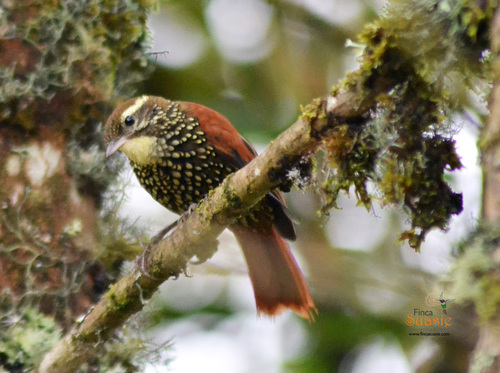
Pearled Treerunner
Margarornis squamiger
A gem of the high Andes, the Pearled Treerunner is a master of vertical exploration, adorned with shimmering spots that mimic sunlight filtering through the cloud forest canopy.
Quick Identification
Size
Length of 15-16 cm (5.9-6.3 in); weight ranging from 14-23 g (0.5-0.8 oz).
Colors
Rich rufous-brown upperparts and tail; underparts are distinctive with white or pale yellow teardrop-shaped 'pearls' outlined in black against a brown background.
Key Features
- Droplet-shaped white spots on breast and belly
- Stiff, spiny-tipped tail used as a prop against bark
- Rufous-chestnut crown and wings
- Sharp, slightly decurved bill for probing moss
- Small, acrobatic climbing posture
When You’ll See Them
Geographic range
Where Does the Pearled Treerunner Live?
The Pearled Treerunner is a quintessential South American highland specialist, found exclusively along the rugged spine of the Andes Mountains. Its native range stretches from the coastal cordillera of Venezuela through the humid highlands of Colombia and Ecuador into the vast montane forests of Peru and western Bolivia. While there are unconfirmed reports of its presence in far northern Argentina, it remains most concentrated in the misty, epiphyte-laden forests of the central and northern Andes.
Basemap © OpenStreetMap contributors
Behavior
The Pearled Treerunner is a master of vertical exploration, acting much like a nuthatch or woodcreeper of the high Andes. It is most frequently observed hitching its way up mossy tree trunks and along horizontal limbs, using its stiff, spiny tail to balance as it probes for hidden prey. Unlike many solitary forest birds, the treerunner is a social creature and is almost always found as a nuclear member of mixed-species foraging flocks, often traveling alongside tanagers and wood-warblers.
These birds are remarkably active and rarely stay in one spot for long. They move with a jerky, hitching motion, sometimes even hanging upside down to inspect the underside of a branch. While they are generally shy toward humans, their constant movement and distinctive 'peeking' behavior around tree trunks make them a delight to observe for those patient enough to track a moving flock through the misty cloud forest.
EverydayEarth exclusive
Camera Tips
Capturing a Pearled Treerunner on camera requires focusing on the vertical structures of the forest. Place your camera on a moss-covered trunk or a thick, horizontal limb that is heavily laden with epiphytes or bromeliads. Because these birds follow mixed-species flocks, setting your camera near a known 'bird path' in the cloud forest where flocks pass daily is your best bet for success.
Standard bird feeders rarely attract this species, as they are strict insectivores. However, if you are in a backyard setting adjacent to Andean forest, maintaining native trees with healthy moss growth is the best natural lure. Use a high-speed trigger setting on your AI camera, as their 'hitching' movements are rapid and jerky, which can result in motion blur on slower devices.
Angle the camera slightly upward to capture the 'pearls' on their underparts, which are their most diagnostic feature. Since cloud forests are often dimly lit, ensure your camera has excellent low-light performance or a fast lens to handle the frequent fog and canopy shade. Early morning hours, just as the mist begins to lift, offer the best natural light and peak activity levels for these restless climbers.
Similar Species
Species that look similar or are commonly confused with Pearled Treerunner.
Frequently Asked Questions
Record Pearled Treerunner at your habitat
Connect a camera to start building your own species record — AI identifies every visitor automatically.