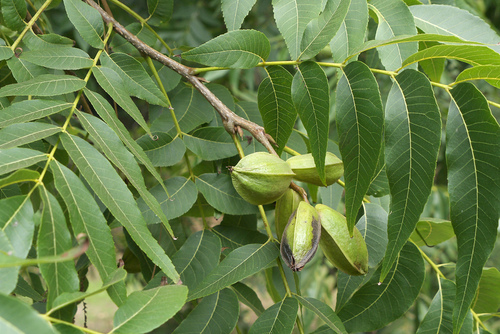
pecan
Carya illinoinensis
A towering giant of the American South, the pecan is more than just a source of delicious nuts—it's a massive ecosystem hub. Whether standing in a wild river bottom or a suburban backyard, these trees provide vital food and shelter for dozens of wildlife species.
Quick Identification
Size
Height: 20–40 m (70–130 ft); Spread: 12–23 m (40–75 ft); Trunk diameter: up to 2 m (6.6 ft)
Colors
Dark green leaves, grayish-brown bark, green husks that turn brown and woody upon maturity
Key Features
- Large deciduous tree reaching 100+ feet
- Pinnately compound leaves with 9-17 sickle-shaped leaflets
- Deeply furrowed, scaly gray-brown bark
- Oblong nuts encased in a green husk that splits into four valves
When You’ll See Them
Geographic range
Where Does the pecan Live?
Native to the central and southern United States and northern Mexico, the pecan is most at home along the fertile banks of the Mississippi River and its tributaries. While its wild roots are firmly planted in the American South, from Texas and Oklahoma to Georgia, its value as a commercial crop has led to widespread cultivation across the southern tier of the U.S. and parts of South Africa, Australia, and China. Today, it remains a quintessential symbol of the American landscape, flourishing in temperate to subtropical climates with long, hot summers.
Basemap © OpenStreetMap contributors
Behavior
The pecan is a long-lived deciduous powerhouse, often reaching ages of over 300 years. As a member of the hickory family, it is known for its alternate leaf arrangement and wind-pollination strategy. In early spring, the tree produces pendulous male catkins and inconspicuous female flowers on the same tree, relying on the breeze rather than insects to ensure the next generation of nuts.
In the wild, pecans are social trees, often forming vast groves in river bottomlands. They play a crucial role in the ecosystem, providing high-energy mast for a variety of wildlife, from squirrels and crows to deer and turkeys. Their growth is moderate to fast, especially when located near water sources where they can tap into deep alluvial soils.
EverydayEarth exclusive
Camera Tips
Capturing the majesty of a pecan tree requires a different approach than tracking animals. To monitor the tree’s health and the wildlife it attracts, mount your camera on a nearby fence post or a different tree at a distance of 15 to 20 feet. This wide-angle perspective allows you to see the entire canopy and the activity at the base. If you're interested in the 'nut thieves,' point your camera toward the lower trunk or large horizontal branches during late autumn when the husks begin to split.
For high-quality images of the serrated leaves and developing nuts, use a camera with a good macro or close-focus capability. Position the lens about 3 to 5 feet from a low-hanging branch. Because pecans are tall, most of the action happens high up; if you can safely mount a camera higher in the canopy using a ladder or specialized strap, you will capture incredible footage of squirrels, woodpeckers, and blue jays competing for the harvest.
Time-lapse mode is particularly rewarding with pecans. Set your camera to take one or two photos a day from early spring through late fall. This will document the dramatic transformation from bare winter branches to the lush green of summer and finally the golden-brown harvest. Ensure your camera is oriented to avoid direct midday sun glare, which can wash out the details of the bark and foliage.
Similar Species
Species that look similar or are commonly confused with pecan.
Frequently Asked Questions
Record pecan at your habitat
Connect a camera to start building your own species record — AI identifies every visitor automatically.