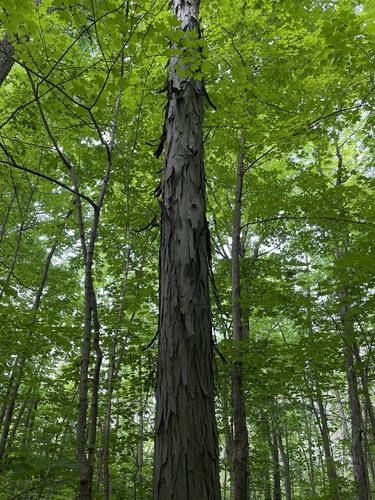
shagbark hickory
Carya ovata
An icon of the eastern deciduous forest, the shagbark hickory is easily recognized by its wild, peeling bark. It serves as a vital 'wildlife hotel,' offering high-protein nuts and secure roosting spots for bats and birds.
Quick Identification
Size
20-30m (65-100ft) tall, with a trunk diameter of 0.6-0.9m (2-3ft)
Colors
Ash-gray bark peeling in long strips; bright yellow-green leaflets turning golden-brown in autumn
Key Features
- Distinctive shaggy gray bark peeling in long vertical strips
- Leaves typically feature 5 leaflets with finely serrated edges
- Large, round nuts encased in a thick, four-sectioned green-to-brown husk
- Straight, slender trunk with a high, narrow crown in forest settings
When You’ll See Them
Geographic range
Where Does the shagbark hickory Live?
The shagbark hickory is native to the temperate regions of eastern North America. Its range spans from southeastern Canada, through the Great Lakes region, and down into the southeastern United States as far as Georgia and Texas. While it is a staple of the deciduous forests of the Midwest and Appalachia, isolated populations also exist in the high-altitude mountains of northeastern Mexico, marking the southern limit of the genus.
Basemap © OpenStreetMap contributors
Behavior
The shagbark hickory is a slow-growing but incredibly resilient pillar of the eastern forest, often living for over 200 years. It is most famous for its reproductive strategy known as 'masting.' Every 3 to 5 years, the tree produces an overwhelming abundance of nuts, far more than local wildlife can consume. This ensures that even after squirrels and blue jays have had their fill, many nuts remain to germinate into new seedlings.
Ecologically, the tree acts as a multi-story habitat. While its canopy provides nesting sites for birds, its unique peeling bark creates narrow, protected crevices. These spaces are vital for small mammals and bats, specifically the endangered Indiana bat, which uses the loose bark as a maternity roost. Unlike many other trees, the shagbark hickory is exceptionally wind-firm due to its massive, deep-reaching taproot.
EverydayEarth exclusive
Camera Tips
Capturing a shagbark hickory on your trail camera is best approached by treating the tree as a high-traffic destination rather than a stationary subject. During the 'masting' months of September and October, place your camera on a nearby tree or a low stake about 3 to 5 feet from the ground, aimed toward the base of the hickory. This area becomes a hub of activity for squirrels, chipmunks, wild turkeys, and deer looking for high-fat nuts. Use a fast trigger speed (0.5 seconds or less) to catch the quick movements of foraging rodents.
For a unique perspective, try mounting a camera directly to the trunk, facing downward or across a large limb. The shaggy bark itself is a microcosm of activity; you might capture Brown Creepers (birds) spiraling up the trunk or small mammals ducking behind the bark plates for safety. If your camera has a time-lapse feature, setting it to take a photo every hour during the autumn can beautifully document the dramatic color change of the leaves from vibrant green to glowing golden-bronze.
Lighting is a critical factor when photographing this species. The light-gray, textured bark can easily blow out and look white in direct, midday sun. Position your camera facing north or south to avoid the harsh east-west sun. Early morning or late afternoon sun provides the best 'side-lighting,' which casts small shadows behind the peeling bark strips, accentuating the tree's iconic 'shaggy' texture and making your photos or videos pop.
Similar Species
Species that look similar or are commonly confused with shagbark hickory.
Shellbark Hickory
Has larger nuts and typically 7 leaflets instead of 5; bark is shaggy but twigs have an orange tint.
Pignut Hickory
Bark is tight and interlaced in a diamond pattern rather than peeling in long strips.
Bitternut Hickory
Features distinct sulfur-yellow winter buds and much smoother, tighter bark.
Frequently Asked Questions
Record shagbark hickory at your habitat
Connect a camera to start building your own species record — AI identifies every visitor automatically.