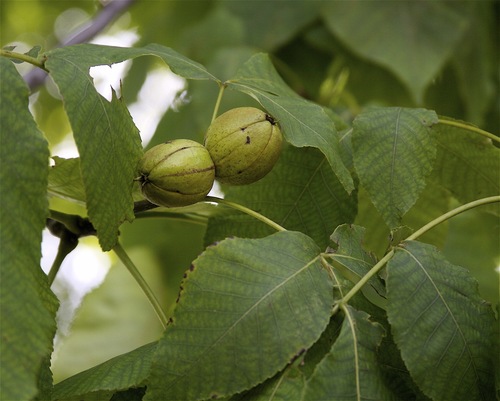
Shellbark Hickory
Carya laciniosa
The Shellbark Hickory is a shaggy-barked monarch of the wetlands, famous for producing the massive 'Kingnuts' that feed a forest full of wildlife. A slow-growing giant, it stands as a testament to the enduring strength of North America's river valleys.
Quick Identification
Size
Typically 23–30 m (75–100 ft) tall with a spread of 15–20 m; nuts are 4–6 cm (1.5–2.5 in) long.
Colors
Grey shaggy bark; dark green leaves turning golden-yellow in autumn; tan to light brown nut husks.
Key Features
- Bark peels in long, vertical strips that curve away from the trunk
- Compound leaves usually with 7 large leaflets
- Produces the largest nuts of all hickory species, often called 'Kingnuts'
When You’ll See Them
Geographic range
Where Does the Shellbark Hickory Live?
The Shellbark Hickory is a native inhabitant of the central and eastern United States, finding its stronghold in the fertile river valleys of the Midwest. Its range stretches from western New York and Pennsylvania across to eastern Kansas and Nebraska, extending as far south as Tennessee and Arkansas. While predominantly an American species, small naturalized populations can be found in southern Ontario, Canada, where it hugs the edges of the Great Lakes.
Basemap © OpenStreetMap contributors
Behavior
The Shellbark Hickory is a slow-growing, long-lived titan of the deciduous forest. Known for its incredible resilience and deep taproot, it can survive for centuries, often reaching ages of 300 years or more. It is a biological 'anchor' in its ecosystem, providing stable nesting sites in its shaggy bark and a massive annual food source through its heavy nut production.
Unlike many other trees, the Shellbark Hickory is a bottomland specialist, meaning it thrives in areas that experience seasonal flooding. It interacts with its environment by producing high-density, flexible wood and nutrient-rich nuts. While it doesn't 'move' in the traditional sense, its life cycle is a masterclass in patience, as it may take 10 to 40 years before it begins producing its first crop of seeds.
EverydayEarth exclusive
Camera Tips
When setting up a camera to capture the life around a Shellbark Hickory, focus your efforts on the 'Kingnut' season in early autumn. Position your camera about 2–3 feet off the ground, aimed at the base of the trunk or a nearby flat log. This is where squirrels, chipmunks, and even wild turkeys will congregate to forage for the massive nuts. Because these nuts are heavy, animals often pause to manipulate them, giving you the perfect window for a clear photo.
To capture the more elusive residents, try mounting a camera 5–6 feet up a neighboring tree, angled slightly downward toward the shaggy bark of the Shellbark. Many species of bats and small birds like Brown Creepers use the peeling bark 'shingles' as roosting or nesting sites. Setting your camera to a high-sensitivity trigger or using a 'Time Lapse' mode can help you catch these quick movements that might otherwise be missed by standard motion sensors.
Don't ignore the night! While the tree itself is stationary, the Shellbark Hickory is a hub for nocturnal activity. Flying squirrels are particularly fond of hickory nuts, and the tree's height makes it a perfect launching pad. Use a camera with a high-quality infrared flash to capture these gliders as they navigate the canopy. If your camera allows for video, set it to 10-second bursts to capture the fascinating social interactions between foragers at the base of the tree.
Similar Species
Species that look similar or are commonly confused with Shellbark Hickory.
Frequently Asked Questions
Record Shellbark Hickory at your habitat
Connect a camera to start building your own species record — AI identifies every visitor automatically.