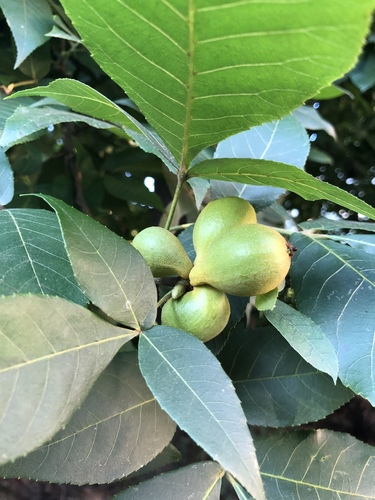
pignut hickory
Carya glabra
A majestic staple of the American landscape, the pignut hickory is famous for its shock-resistant wood and golden autumn beauty. It acts as a vital woodland supermarket, feeding dozens of species with its pear-shaped nuts.
Quick Identification
Size
Height: 15–25 m (50–80 ft); Trunk diameter: 0.3–1 m (1–3 ft); Spread: 9–12 m (30–40 ft)
Colors
Dark green summer foliage; brilliant golden-yellow in autumn; gray to brown bark
Key Features
- Pinnately compound leaves with 5-7 leaflets
- Pear-shaped nuts with a thin, bitter-to-sweet husk
- Relatively smooth bark that becomes tight and interlaced with age
- Brilliant golden-yellow fall color
When You’ll See Them
Geographic range
Where Does the pignut hickory Live?
The pignut hickory is a quintessential resident of the Eastern United States and southeastern Canada. Its native range stretches from the cool woodlands of southern Ontario and New Hampshire down to the humid subtropics of central Florida. To the west, it reaches into the rolling hills of eastern Texas, Oklahoma, and Kansas, thriving most abundantly in the Appalachian Highlands and the Ohio River Valley. It is a resilient species that adapts well to the varying climates found across North America's broadleaf forest belt.
Basemap © OpenStreetMap contributors
Behavior
The pignut hickory is a slow-growing, long-lived hardwood that serves as a cornerstone of the eastern deciduous forest. While the tree itself remains stationary, it is a hub of constant biological activity. It is a 'masting' species, which means it produces massive quantities of nuts in irregular cycles—usually every 1 to 2 years—to ensure that at least some seeds survive the heavy foraging of local wildlife.
Beyond its ecological role, the pignut hickory has a storied history with humans. Its wood is legendary for its density, hardness, and shock resistance. Historically, it was the primary choice for making broom handles (earning it the name 'broom hickory') and wheel spokes. Today, it remains a favorite for tool handles and high-quality firewood, as it burns slowly and produces intense heat.
EverydayEarth exclusive
Camera Tips
To capture the wildlife that depends on the pignut hickory, position your camera about 3 to 5 feet off the ground, angled slightly downward toward the base of the trunk. During the nut-ripening months of September and October, this area becomes a high-traffic zone for squirrels, chipmunks, and even white-tailed deer. Use a high-speed trigger setting to catch the rapid movements of rodents as they forage and cache nuts for the winter.
For a unique perspective, try mounting a trail camera higher up in the canopy if you have a safe way to do so. Many species, like the elusive Southern Flying Squirrel, are strictly nocturnal and spend their lives in the branches. Setting your camera to 'Video Mode' with a 15-second duration and high-intensity infrared flash will help you record these nocturnal acrobats as they navigate the hickory's limbs and peel the thin husks from the nuts.
Because the pignut hickory creates a very dense canopy, lighting can be a challenge during the day. If possible, place your camera on the eastern or southern edge of the tree's drip line to take advantage of the best natural light. If you are using an AI-powered camera that categorizes species, ensure the lens is clean of any sticky sap or dust, which can accumulate during the spring pollen season and blur the identification of birds nesting in the high branches.
Similar Species
Species that look similar or are commonly confused with pignut hickory.
Frequently Asked Questions
Record pignut hickory at your habitat
Connect a camera to start building your own species record — AI identifies every visitor automatically.