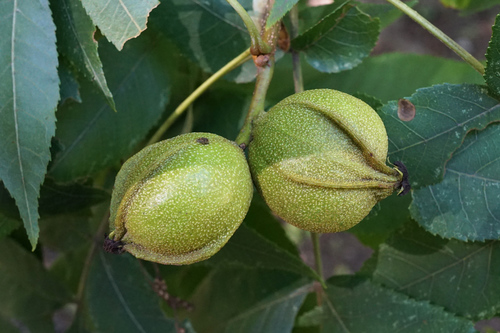
bitternut hickory
Carya cordiformis
The bitternut hickory is the most widespread of the North American hickories, famous for its striking sulphur-yellow winter buds. This hardy tree provides essential shelter and a critical late-season food source for backyard wildlife.
Quick Identification
Size
Height of 50–100 ft (15–30 m); trunk diameter of 12–36 in (30–90 cm)
Colors
Grayish-brown bark with tight ridges; bright green compound leaves; signature sulphur-yellow winter buds
Key Features
- Distinctive bright sulphur-yellow winter buds
- Pinnately compound leaves with 7-11 slender leaflets
- Thin-shelled nuts with a four-winged husk
- Tight, gray bark with a shallow diamond-patterned texture
When You’ll See Them
Geographic range
Where Does the bitternut hickory Live?
Native to the temperate regions of North America, the bitternut hickory boasts one of the most expansive ranges of any hickory species. It is found throughout the eastern United States, stretching from the Atlantic coast westward to the edge of the Great Plains, and extending from the Gulf of Mexico up into southeastern Canada. This tree is a staple of the Mississippi Valley and the Great Lakes region, thriving in a variety of soil types across its vast territory.
Basemap © OpenStreetMap contributors
Behavior
The bitternut hickory is a resilient and relatively fast-growing member of the walnut family. Unlike the more famous shagbark hickory, which sheds its bark in large plates, the bitternut maintains a much tighter, interlacing bark pattern throughout its lifespan. It is recognized as the most cold-hardy of all hickory species, pushing its range further north into Canada than any of its relatives. It serves as a vital structural tree in forest ecosystems, often acting as a pioneer species that stabilizes soil in moist lowlands.
While the tree is a long-lived perennial, it is the shortest-lived of the hickories, typically reaching maturity around 200 years. It provides a dense canopy that serves as a nesting site for various songbirds and a sanctuary for tree-dwelling mammals. Although its nuts are famous for their high tannin content and bitter taste, the tree remains a central figure in the forest food web, providing a reliable food source during lean winters when other mast crops have been depleted.
EverydayEarth exclusive
Camera Tips
Capturing the bitternut hickory on a trail camera is less about catching the tree in motion and more about documenting the ecosystem that revolves around it. Mount your camera at a height of 4 to 5 feet on an adjacent tree, angling it slightly upward to frame the hickory’s trunk and lower canopy. This positioning is excellent for capturing the seasonal change of the leaves—which turn a stunning clear yellow in the fall—and for spotting woodpeckers or nuthatches that frequent the bark for insects.
If your goal is to record wildlife interactions, place the camera near the base of the trunk during the late autumn months. Even though the nuts are bitter to human tastes, squirrels, mice, and even wild turkeys will forage in the leaf litter beneath these trees when preferred acorns are scarce. Set your camera to a high-trigger sensitivity to catch these small, quick-moving mammals as they navigate the roots. Using a time-lapse setting can also be a fantastic way to document the tree’s rapid leaf-out in the spring.
During the winter, the bitternut hickory is one of the easiest trees to identify on camera because of its bright yellow buds. Position your camera for a close-up on a low-hanging branch if possible. The contrast of the sulphur-colored buds against a snowy or grey winter background provides a sharp focal point for AI detection. Avoid placing the camera directly facing the sun, as the light reflecting off the hickory’s relatively smooth upper bark can cause overexposure in your shots.
Similar Species
Species that look similar or are commonly confused with bitternut hickory.
Shagbark Hickory
Shagbark has distinctly peeling, shaggy bark and much larger, edible nuts compared to the tight bark and bitter nuts of the bitternut.
Pignut Hickory
Pignut hickory has tan or reddish-brown buds and usually only 5-7 leaflets, whereas the bitternut has yellow buds and 7-11 leaflets.
Pecan
Pecans have more numerous leaflets (11-17) and produce the well-known sweet, edible commercial nuts.
Frequently Asked Questions
Record bitternut hickory at your habitat
Connect a camera to start building your own species record — AI identifies every visitor automatically.