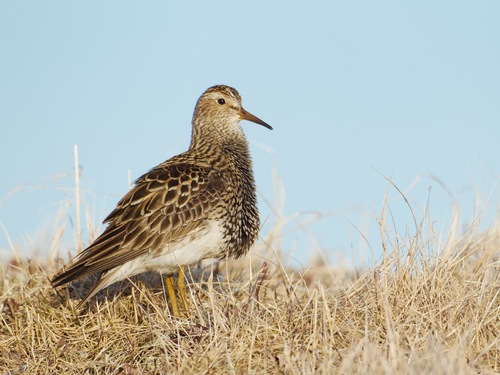
Pectoral Sandpiper
Calidris melanotos
A long-distance traveler with a distinctive 'bib,' the Pectoral Sandpiper is the sophisticated wanderer of the wetlands. Look for them on muddy edges where their yellowish legs and upright posture set them apart from the crowd.
Quick Identification
Size
Length: 19–23 cm (7.5–9.1 in); Wingspan: 38–46 cm (15–18 in); Weight: 45–105 g (1.6–3.7 oz)
Colors
Upperparts are a rich, scaly brown and black; breast features a dense, dark-streaked 'bib' that ends abruptly at a clean white belly; legs are yellowish-green.
Key Features
- Distinct sharp demarcation between the streaked breast and white belly
- Yellowish to greenish-yellow legs
- Slightly decurved bill with a dull yellow base
- Longer-necked and more upright posture than many other small sandpipers
When You’ll See Them
Behavior
The Pectoral Sandpiper is a fascinating traveler, known for one of the longest migration routes of any shorebird, traveling from Arctic breeding grounds to South American or Oceanian wintering spots. Unlike many shorebirds that prefer open sand, 'Pecs' often frequent grassy wetlands and damp mudflats where they walk slowly, picking or probing the soft earth for food. They are somewhat more cryptic and less flighty than other peeps, often freezing in place if they sense a predator.
During the breeding season, males are famous for their inflatable throat sacs, which they use to make hollow, hooting sounds to attract females. While you likely won't see this display in a suburban backyard or during migration, their social behavior remains interesting; they often forage in small, loose groups rather than the massive, synchronized flocks seen in other sandpiper species. They are generally tolerant of humans if approached slowly, making them excellent subjects for shoreline photography.
EverydayEarth exclusive
Camera Tips
Capturing a Pectoral Sandpiper requires a strategy focused on ground-level action. Because these birds forage along the 'muck line'—the interface between shallow water and wet grass—you should position your camera just 2 to 5 inches off the ground. A waterproof casing is essential, as the best spots are often prone to minor flooding or heavy dew. Angle the camera slightly upward if you are placing it in a depression, or keep it level with the mudflat to get that professional 'low-profile' look that makes the bird stand out against a blurred background.
Since sandpipers are motivated by food, look for areas of 'edge habitat.' If you have a backyard pond or a low spot in a field that holds water after a rain, this is your goldmine. You don't necessarily need bait, but maintaining a patch of exposed, damp mud (rather than thick tall grass) will act as a natural lure. They are attracted to the invertebrates that thrive in these micro-habitats. Ensure your camera has a fast trigger speed; while they move slowly when feeding, their head-bobbing and sudden probes can result in motion blur if your shutter speed isn't optimized.
For settings, use a high-sensitivity PIR (motion sensor) because these birds are relatively small and may not trigger less sensitive units. If your camera allows for 'burst mode,' set it to take 3-5 photos per trigger. This increases your chances of catching the bird in a classic upright pose rather than just a blur of feathers as it pecks at the ground. Because they are most active during the golden hours of morning and evening, ensure your camera's low-light performance is toggled to 'high' or 'fast' to prevent grainy images during these peak activity windows.
Similar Species
Species that look similar or are commonly confused with Pectoral Sandpiper.
Least Sandpiper
Much smaller (sparrow-sized) with a finer bill and lacks the sharp 'bib' contrast on the breast.
Baird's Sandpiper
Has much longer wings that extend past the tail and lacks the distinct sharp cutoff on the breast streaking.
Sharp-tailed Sandpiper
Very similar but features a brighter rufous cap and more chevron-shaped spotting on the flanks rather than a clean white belly.
Frequently Asked Questions
Record Pectoral Sandpiper at your habitat
Connect a camera to start building your own species record — AI identifies every visitor automatically.