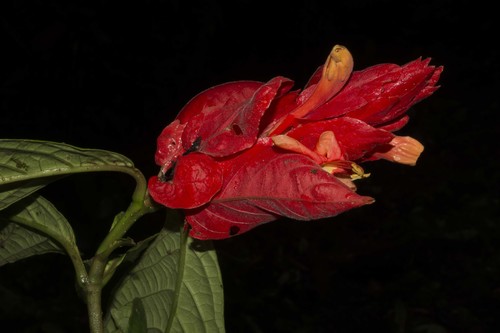
Peruvian Wild Petunia
Ruellia chartacea
With its brilliant scarlet spikes and lush tropical foliage, the Peruvian Wild Petunia is a masterpiece of the Amazonian understory. A favorite of hummingbirds, this striking shrub brings the vibrant energy of the rainforest directly to your backyard camera's view.
Quick Identification
Size
A woody shrub reaching 0.9 to 1.5 meters (3 to 5 feet) in height with a spread of 0.6 to 1 meter (2 to 3 feet).
Colors
Deep forest green leaves with brilliant scarlet-red flower bracts and bright orange-red tubular blossoms.
Key Features
- Vibrant scarlet terminal flower spikes
- Large, glossy dark green lanceolate leaves
- Tubular, nectar-rich flowers approximately 2 inches long
- Woody-based upright evergreen shrub habit
When You’ll See Them
Geographic range
Where Does the Peruvian Wild Petunia Live?
Native to the lush South American continent, the Peruvian Wild Petunia is primarily found in the tropical regions of Peru, Ecuador, and Northern Brazil. It thrives in the humid conditions of the Amazon basin but has become a popular ornamental plant in subtropical regions across the globe. While it remains a forest-dweller in its native range, it is now commonly spotted in botanical gardens and shade-heavy landscapes in Florida, Central America, and Southeast Asia.
Basemap © OpenStreetMap contributors
Behavior
Unlike many other garden plants, it is highly interactive with local fauna. Its tubular, nectar-rich flowers are specifically evolved for ornithophily—pollination by birds. In backyard settings, it serves as a primary nectar source for hummingbirds, who are attracted to the vivid red color. It also provides essential structural cover for small insects and forest-floor lizards within its dense, leafy branches.
EverydayEarth exclusive
Camera Tips
To capture the best footage of visitors to your Peruvian Wild Petunia, position your AI-powered camera approximately 2 to 3 feet away from a fresh bloom spike. Since this plant attracts fast-moving hummingbirds, set your camera to its highest possible frame rate or 'sports' mode to minimize motion blur during hover-feeding. Aim the lens at a slight upward angle to catch the iridescent throat feathers of birds as they dip into the tubular flowers.
Because this species thrives in partial shade, lighting can be tricky for digital sensors. Ensure your camera is positioned to avoid direct lens flare from the sun filtering through the tree canopy, which can wash out the brilliant red of the bracts. Early morning light, specifically between 7 AM and 10 AM, is often the best for capturing both the vibrant color of the plant and the peak activity of its avian pollinators.
In a backyard setting, keep the soil around the plant consistently moist to ensure the flowers remain turgid and attractive to wildlife. If your camera has a 'time-lapse' feature, this is an excellent species for documenting the slow opening of the scarlet bracts over several days, providing a unique look at the plant's development that standard motion-triggering might miss. Position the camera on a stable tripod or mount to ensure the time-lapse remains steady as the plant grows.
Similar Species
Species that look similar or are commonly confused with Peruvian Wild Petunia.
Frequently Asked Questions
Record Peruvian Wild Petunia at your habitat
Connect a camera to start building your own species record — AI identifies every visitor automatically.