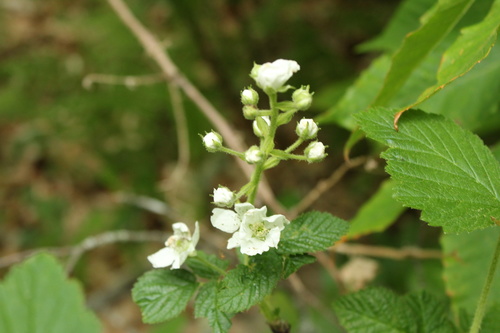
pilated-leaved blackberry
Rubus fruticosus
A cornerstone of the backyard wild, the pilated-leaved blackberry is a thorny fortress that provides sweet rewards and vital sanctuary for countless species. From its delicate summer blooms to its iconic dark fruit, this resilient shrub is a master of survival and a magnet for local wildlife.
Quick Identification
Size
Arching canes reaching 1.5–3 meters (5–10 feet) in length; berries roughly 1–2 cm (0.4–0.8 inches) in diameter.
Colors
Dark green foliage with silvery-green undersides; white to pale pink five-petaled flowers; fruit matures from green to red to glossy black.
Key Features
- Robust arching canes armed with sharp, recurved thorns
- Leaves typically composed of 3 to 5 serrated, oval-shaped leaflets
- Clusters of shiny black aggregate fruits appearing in late summer
- Biennial growth cycle with non-fruiting first-year canes (primocanes) and fruiting second-year canes (floricanes).
When You’ll See Them
Behavior
The pilated-leaved blackberry is a vigorous, perennial shrub known for its ability to colonize large areas quickly. It primarily spreads through a process called 'tip-rooting,' where the ends of long, arching canes touch the soil and sprout new roots, creating dense, impenetrable thickets. These thickets serve as critical 'nursery' habitats, protecting young animals and small birds from larger predators.
Beyond its growth habits, this species acts as a community hub for local fauna. During the late spring and early summer, its blossoms provide a high-energy nectar source for honeybees, bumblebees, and butterflies. As the fruit ripens in late summer, the plant becomes a frantic site of activity for both diurnal and nocturnal foragers. While humans prize the berries for pies and jams, the plant is a fierce defender of its fruit, using its sharp thorns to deter larger herbivores while allowing smaller creatures to navigate the inner branches.
EverydayEarth exclusive
Camera Tips
Capturing the pilated-leaved blackberry on camera is less about the plant itself and more about the incredible 'micro-ecosystem' it supports. To catch the widest variety of wildlife, mount your camera on a stake approximately 2 to 3 feet off the ground, angled slightly downward toward a cluster of ripening berries. This height is the 'sweet spot' for capturing everything from songbirds like Gray Catbirds to mammals like Raccoons and Red Foxes who come to feast on the fallen fruit.
For those interested in the plant's development, use your camera’s time-lapse mode. Set an interval of one photo every 2-3 hours during daylight. Over the course of a month, this will produce a stunning visual of the blossoms transforming into red, then deep black berries. If you are using a trigger-based setup, ensure the 'Sensitivity' is set to High; the movement of small birds flitting between thorny canes can be subtle and easily missed by lower settings.
Lighting is your biggest challenge with blackberries, as the white blossoms can 'blow out' and look like white blobs in direct midday sun. Position your camera facing North or South to avoid direct lens flare. Early morning light (6 AM - 9 AM) provides the best color saturation for the berries and the most active period for pollinators. If you are looking for nocturnal visitors, ensure your IR flash is not too close to the leaves, or the 'white-out' effect from the reflective waxy leaves will obscure the animals.
Finally, consider the seasonal 'lure' effect. During the heat of August, the juice from overripe berries acts as a natural bait. You don't need to add anything; the scent will naturally draw in opossums, skunks, and even deer. Ensure your camera is secured firmly, as larger mammals may nudge the canes—and your camera—while reaching for the highest, sweetest berries.
Similar Species
Species that look similar or are commonly confused with pilated-leaved blackberry.
Frequently Asked Questions
Record pilated-leaved blackberry at your habitat
Connect a camera to start building your own species record — AI identifies every visitor automatically.