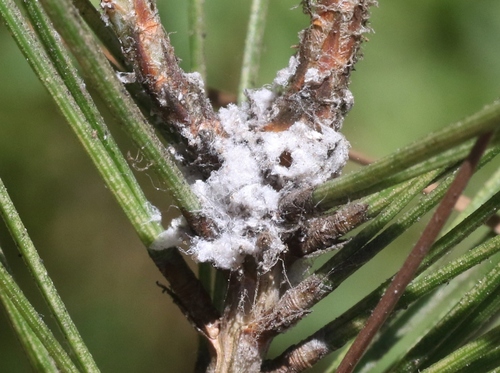
Pine Woolly-aphid
Pineus pini
Look closely at the 'snow' on your pine branches and you might find the Pine Woolly-aphid. These tiny architects shroud themselves in white wax, creating miniature cotton-ball colonies that thrive in the heart of our evergreen forests.
Quick Identification
Size
1.0–1.5 mm (0.04–0.06 inches) in length
Colors
Dark brown to blackish body, typically hidden under thick, white, cottony waxy filaments
Key Features
- Covered in white 'woolly' wax
- Found exclusively on pine trees (Pinus spp.)
- Sedentary colonies on shoots and bark
- Causes yellowing of needles (flagging)
When You’ll See Them
Behavior
The Pine Woolly-aphid is a sedentary sap-sucker that spends the majority of its life anchored to the bark or needles of pine trees. These insects are rarely seen individually; instead, they are recognized by the dense, white, waxy secretions they produce. This 'wool' serves as a multi-purpose shield, protecting the soft-bodied aphids from predators like ladybugs, preventing them from drying out, and acting as a raincoat during heavy storms.
While they are technically capable of movement during their 'crawler' stage, adult females typically remain stationary. They insert their needle-like mouthparts into the tree's vascular system to drink phloem sap. Unlike many other aphid species, Pine Woolly-aphids do not produce significant amounts of honeydew, so you won't usually see the sticky residue or 'sooty mold' associated with other garden pests. They are a fascinating example of a specialist species that has evolved to thrive specifically on the chemistry of pine trees.
EverydayEarth exclusive
Camera Tips
Capturing the Pine Woolly-aphid on a trail camera or backyard AI camera requires a shift in strategy because these insects are stationary and extremely small. Traditional motion-triggering will rarely work for a creature that doesn't move. Instead, utilize your camera's 'Time-Lapse' or 'Scheduled Capture' mode. Set the camera to take a high-resolution photo every 30 minutes during daylight hours. This allows you to observe the growth of the waxy colony over several weeks, providing a fascinating look at their lifecycle that the naked eye usually misses.
For the best visual results, you must use a macro lens attachment or a camera with a very short minimum focal distance (close-focus). Mount the camera on a sturdy branch or a dedicated tripod positioned just 6 to 12 inches away from an infested pine shoot. Because the white wax is highly reflective, avoid placing the camera in direct, midday sun, which will 'blow out' the highlights and hide the details of the insects. Early morning light or a cloudy day provides the soft, even illumination needed to see the texture of the woolly filaments.
If your AI camera supports custom detection zones, draw your zone tightly around a specific cluster of aphids. While the aphids themselves won't trigger the camera, their predators will. By monitoring a Pine Woolly-aphid colony, you are likely to capture high-quality footage of Ladybugs, Hoverfly larvae, and Lacewings—the 'lions' of the insect world—coming in to hunt. This turns a stationary subject into a hub of backyard activity.
Similar Species
Species that look similar or are commonly confused with Pine Woolly-aphid.
Frequently Asked Questions
Record Pine Woolly-aphid at your habitat
Connect a camera to start building your own species record — AI identifies every visitor automatically.