Balsam Woolly Adelgid
Adelges piceae
A microscopic invader with a massive impact, the Balsam Woolly Adelgid hides beneath a coat of white wax while reshaping the high-altitude forests of North America.
Quick Identification
Size
Adults measure 0.5 mm to 2.0 mm (0.02 to 0.08 inches) in length.
Colors
Bright white waxy secretions covering a dark purple or black body; eggs are light amber to reddish-brown.
Key Features
- White cottony or 'woolly' tufts on the trunk and branches of fir trees
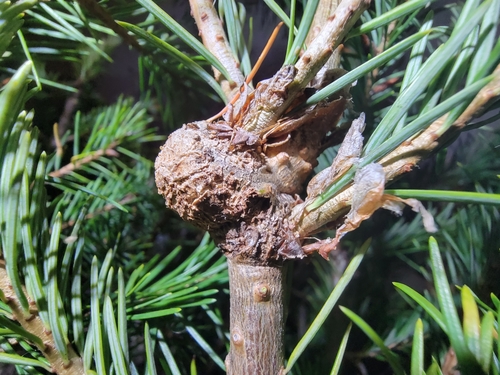
- Abnormal swelling of twig nodes known as 'gouting'
- Microscopic size, appearing only as white fuzz to the naked eye
- Wingless and stationary as adults
When You’ll See Them
Geographic range
Where Does the Balsam Woolly Adelgid Live?
Native to the temperate forests of Central and Southern Europe, the Balsam Woolly Adelgid was introduced to North America around 1900. It now thrives across the Pacific Northwest, the Northeastern United States, and the high-elevation Southern Appalachian Mountains. It is also widely established throughout Southeastern Canada, following the natural range of its primary host trees.
Basemap © OpenStreetMap contributors
Behavior
The Balsam Woolly Adelgid is a sedentary parasite that spends the majority of its life cycle attached to a single spot on a fir tree. Once a young 'crawler' finds a suitable location on the bark, it inserts its long, thread-like mouthparts into the tree to feed on sap. After this point, the insect becomes permanent, losing its legs and secreting a white, waxy 'wool' that protects it from predators and the elements.
These insects are particularly devastating because they inject a toxic saliva into the tree while feeding. This saliva causes the tree to produce abnormal wood tissue, which blocks the flow of water and nutrients. In North American species like the Fraser Fir, this leads to a slow death over several years, as the tree essentially starves and dehydrates. Because they are all female and reproduce via parthenogenesis (without mating), a single individual can rapidly start a massive infestation.
EverydayEarth exclusive
Camera Tips
Capturing the Balsam Woolly Adelgid on camera requires a shift in perspective, as these insects are too small for standard wildlife triggers. Instead of waiting for movement, set your AI-powered camera to 'Macro' mode and focus on the bark of fir trees. Look for what appears to be 'snow' or white lint stuck in the crevices of the bark; these are the waxy secretions of the adelgids. Use a high-resolution setting to ensure that the individual woolly tufts are distinct rather than a blurry white mass.
Placement is key for monitoring tree health. Position your camera about 3 to 5 feet off the ground, facing the main trunk of a Balsam or Fraser fir. In heavy infestations, the entire trunk can look like it has been whitewashed. If you are tracking the spread, check the twig nodes at the ends of branches for 'gouting'—the distinctive swelling caused by their feeding. This is often the first visible sign of their presence before the 'wool' becomes obvious on the trunk.
Lighting is your best friend when photographing these tiny pests. Direct sunlight can wash out the white wax, making it look like a featureless blob. Try to capture your images during the 'golden hour' or on overcast days when the soft light highlights the texture of the woolly fibers. If your camera has a flash, use it sparingly as the wax is highly reflective. Monitoring the same spot over several months can provide a fascinating (and vital) time-lapse of how an infestation progresses throughout the season.
Similar Species
Species that look similar or are commonly confused with Balsam Woolly Adelgid.
Hemlock Woolly Adelgid
Found exclusively on hemlock trees; tufts are usually found at the base of needles rather than on the main trunk bark.
Pine Bark Adelgid
Specializes in white pines and other pine species; visually similar but does not infest fir trees.
Beech Bark Scale
Also produces white waxy wool but is found exclusively on American Beech trees and is associated with a specific fungus.
Frequently Asked Questions
Record Balsam Woolly Adelgid at your habitat
Connect a camera to start building your own species record — AI identifies every visitor automatically.