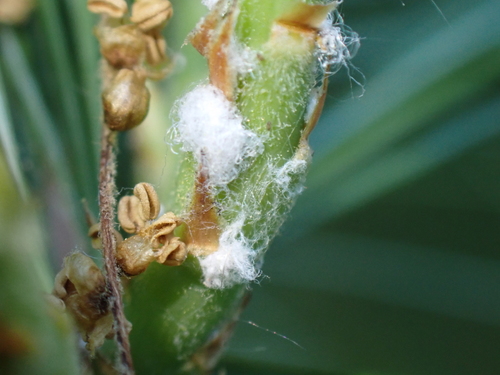
Pine Bark Adelgid
Pineus strobi
Transform your view of the Eastern White Pine by zooming in on the Pine Bark Adelgid. These tiny architects create snowy, woolly fortresses on tree trunks, hiding a complex world of sap-suckers and the predators that hunt them.
Quick Identification
Size
Individual insects are microscopic (0.5–1.0 mm), but colonies appear as white patches 2–30 cm (1–12 inches) in length.
Colors
Bright white waxy secretions covering dark purple to black soft-bodied insects.
Key Features
- White, cottony or woolly patches on pine bark
- Host-specific primarily to Eastern White Pine
- Sticky waxy filaments that protect the colony
- Sedentary behavior once feeding begins
When You’ll See Them
Behavior
The Pine Bark Adelgid is a tiny, sap-sucking insect that spends most of its life anchored to the bark of Eastern White Pines. While an individual insect is nearly invisible to the naked eye, they are famous for the collective 'wool' they produce. These are actually waxy filaments secreted by the insects to protect themselves from predators and desiccation. You will most often find them in shaded areas of the trunk or on the undersides of large branches, where they congregate in large, snowy-looking patches.
Despite their somewhat alarming appearance, these insects are generally harmless to mature, healthy trees. They follow a complex life cycle that often involves several generations per year, including both winged and wingless forms. In a backyard setting, they are a fascinating example of a micro-ecosystem, as their presence often attracts secondary visitors like hoverfly larvae or ladybugs that come to feast on the defenseless adelgids.
EverydayEarth exclusive
Camera Tips
Capturing the Pine Bark Adelgid requires a shift in perspective, as these insects are tiny and do not move across the landscape like a bird or mammal. To get the best results with your AI-powered camera, you must use a macro lens attachment or a camera capable of 'super-macro' focus. Position your camera on a tripod or mount it directly to a secondary branch, focusing the lens on a fresh patch of white 'wool' on the main trunk. Aim for a distance of 2 to 5 inches depending on your lens's focal minimum.
Because the adelgids themselves are sedentary, the most rewarding way to document them is through time-lapse photography. Set your camera to take a high-resolution photo every 30 minutes over the course of several days during the spring. When played back, you will see the white waxy patches 'grow' and expand across the bark as the colony multiplies—a process that is invisible to the casual observer.
Lighting is your biggest challenge under the canopy of a pine tree. Use a diffused external light source or wait for bright but overcast days to avoid harsh shadows and 'blown out' whites on the waxy filaments. If your camera has a trigger-based AI, it likely won't fire for the adelgids themselves; instead, set the camera to 'Time Lapse' or 'Periodic Capture' mode. You may also capture fascinating footage of predators like Lacewings or Syrphid fly larvae as they navigate the waxy forest to hunt the adelgids.
Seasonal timing is key. Start your camera monitoring in early April when the 'overwintering' nymphs begin to secrete new wax. By late May, the colonies are at their most 'fluffy' and photogenic. If you notice ladybugs or small birds like Nuthatches hovering around the patches, reposition your camera to a slightly wider angle to capture these interactions, as they are often coming to feed on the adelgid colony.
Similar Species
Species that look similar or are commonly confused with Pine Bark Adelgid.
Frequently Asked Questions
Record Pine Bark Adelgid at your habitat
Connect a camera to start building your own species record — AI identifies every visitor automatically.