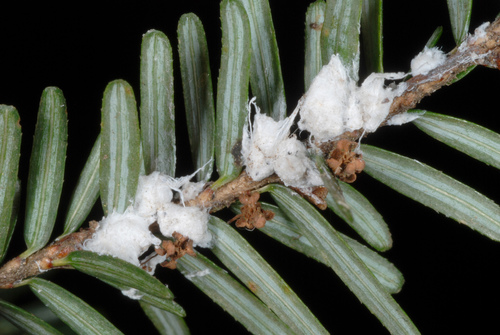
Hemlock Woolly Adelgid
Adelges tsugae
The Hemlock Woolly Adelgid may be tiny, but its impact on our forests is monumental. Identifiable by the white, cottony masses it leaves on hemlock branches, this invasive insect is a critical species to monitor for any backyard conservationist.
Quick Identification
Size
Adults are microscopic, approximately 0.8 mm to 1.5 mm (1/32 to 1/16 inch); woolly egg masses are 1 mm to 3 mm (1/8 inch).
Colors
Adults are dark reddish-brown to black; most commonly recognized by their white, waxy, cotton-like secretions.
Key Features
- White, cottony waxy masses on the underside of hemlock twigs
- Found specifically at the base of needles
- Infested trees show graying or thinning needle canopies
When You’ll See Them
Behavior
The Hemlock Woolly Adelgid (HWA) is a persistent, sap-sucking insect that behaves quite differently from many common backyard bugs. While most insects are active in the heat of summer, the HWA thrives in the cold. They are most active from autumn through late spring, spending their lives anchored to the base of hemlock needles. Once they find a feeding spot, they insert their long, thread-like mouthparts into the tree to drain nutrients, remaining stationary for the rest of their development.
These insects are primarily spread through passive transport rather than active flight. Because the nymphs (known as 'crawlers') are extremely small and sticky, they hitch rides on the feet of birds, the fur of squirrels, or are simply carried by the wind from one tree to the next. In North America, these insects are almost exclusively female and reproduce asexually, meaning a single individual can start an entire infestation that can kill a mature hemlock tree in 4 to 10 years.
EverydayEarth exclusive
Camera Tips
Because Hemlock Woolly Adelgids are stationary and incredibly small, capturing them on a standard trail camera requires a specialized setup. Instead of relying on motion triggers, use your camera’s 'Time Lapse' or 'Scheduled Image' mode. This is the most effective way to monitor a specific branch over several months to track the growth of the white 'wool' and the overall health of the tree. If your AI camera supports macro-focusing, position it within 12-18 inches of the underside of a hemlock branch where you suspect an infestation.
The best visual results occur during the winter months when the white waxy secretions are at their fluffiest and most distinct. Mount your camera on a steady tripod or a neighboring tree trunk to avoid motion blur from wind. Aim the lens at the newest growth on the hemlock, as adelgids prefer the succulent tips of the branches. Good lighting is essential; try to position the camera so that the branch is backlit or side-lit by the sun, which can make the white waxy masses 'pop' against the dark green needles.
If you are interested in the wider ecosystem, use your camera to monitor the birds that visit the infested branches. Many birds, like Chickadees and Nuthatches, are inadvertently responsible for spreading the 'crawlers' to new trees. By setting your camera to a high-speed burst mode triggered by bird activity, you can document the interaction between local wildlife and the infested hemlock, providing valuable data on how these pests move through your neighborhood.
Similar Species
Species that look similar or are commonly confused with Hemlock Woolly Adelgid.
Frequently Asked Questions
Record Hemlock Woolly Adelgid at your habitat
Connect a camera to start building your own species record — AI identifies every visitor automatically.