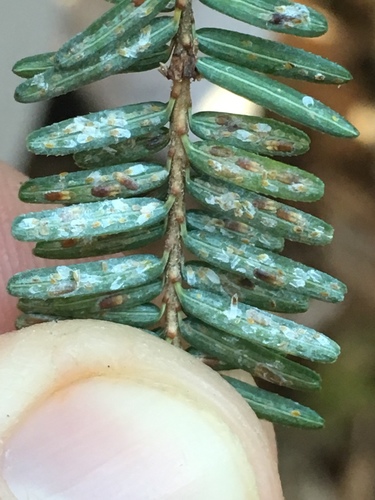
Elongate hemlock scale
Fiorinia externa
A tiny traveler with a massive impact, the elongate hemlock scale hides on the underside of conifer needles, creating waxy empires that can reshape entire forests.
Quick Identification
Size
Adult females are 1.5–2 mm (0.06–0.08 in) long; males are slightly smaller and narrower.
Colors
Females have a translucent, yellowish-brown or amber waxy cover; males have a white, felt-like cover.
Key Features
- Flattened, elongated pear-shaped body
- Translucent amber-colored female shell
- White waxy secretions on the underside of needles
- Stationary life stage attached to conifer needles
When You’ll See Them
Geographic range
Where Does the Elongate hemlock scale Live?
Originally native to East Asia, particularly Japan and China, the elongate hemlock scale has become a widespread invasive species. In the United States, its primary range spans the Northeast and Mid-Atlantic regions, reaching from Georgia northward to Maine and stretching as far west as Michigan. It continues to expand into new territories wherever its host trees—specifically hemlock and fir—are present in high densities.
Basemap © OpenStreetMap contributors
Behavior
The elongate hemlock scale is a sedentary insect that spends the majority of its life cycle firmly attached to the underside of conifer needles. Once the microscopic 'crawler' stage finds a suitable feeding site, it inserts its long, thread-like mouthparts into the plant's stomata to suck out cell fluids. This feeding process is highly efficient but eventually drains the tree of vital nutrients, leading to a thin canopy and yellowing foliage.
Unlike many other garden insects, these scales do not move once they have settled. They produce a protective waxy secretion that covers their bodies, acting as a shield against predators and environmental stress. In North America, they often produce two generations per year, with activity peaking in late spring and again in late summer, depending on the local temperature.
EverydayEarth exclusive
Camera Tips
Capturing the elongate hemlock scale requires a specialized approach because of their minuscule size and stationary nature. To get clear images, you must use a camera equipped with a macro lens or a dedicated 'micro' mode. Position the camera lens very close—usually between 1 and 4 inches—from the underside of a hemlock or fir branch. Since these insects are often found in the deep shade of the inner canopy, external lighting is essential. A ring light or a diffused LED panel will help illuminate the translucent brown covers of the females against the dark green needles.
For those using AI-powered backyard cameras, mount the device on a stable tripod and angle the lens upward to view the needle undersides. Standard motion-triggering will likely not work for adult scales, so set your camera to 'Time Lapse' mode. A capture every 15 to 30 minutes during the spring months (May and June) is the best way to document the 'crawler' stage when the tiny yellow nymphs are actually moving across the branch.
Pay close attention to the focus. Because needles are thin and move in the wind, even a slight breeze can ruin a shot. Use a 'focus stacking' feature if your camera supports it, or try to secure the branch gently with a clip to minimize movement. High-resolution settings are non-negotiable here; you need enough detail to see the parallel sides of the scale cover to distinguish them from other common garden pests.
Similar Species
Species that look similar or are commonly confused with Elongate hemlock scale.
Frequently Asked Questions
Record Elongate hemlock scale at your habitat
Connect a camera to start building your own species record — AI identifies every visitor automatically.