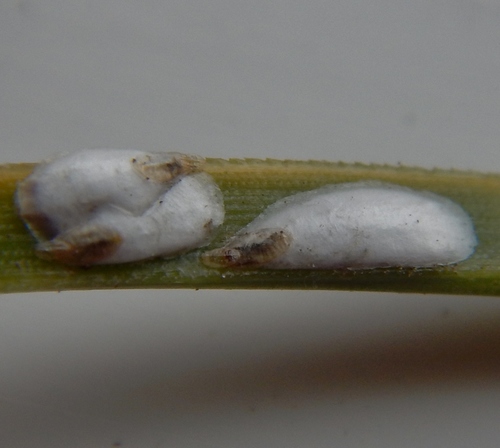
pine needle scale
Chionaspis pinifoliae
Transforming green needles into white-flecked landscapes, the pine needle scale is a master of camouflage and stationary survival. These tiny armored insects tell a story of resilience and the hidden life cycles occurring within our backyard evergreens.
Quick Identification
Size
Adult female scales are 2.5–3 mm (0.10–0.12 in) long; males are smaller at 1 mm (0.04 in)
Colors
Bright white waxy covering with a small yellow or orange spot (the exuviae) at one end; crawlers are yellowish-orange
Key Features
- White, elongated oyster-shell-shaped scales
- Appears as white flecks or 'fake snow' on conifer needles
- Yellowish-orange crawler stage barely visible to the naked eye
- Stationary adult females lacking visible legs or antennae
When You’ll See Them
Behavior
Pine needle scale insects lead a sedentary life that revolves around a specialized protective armor. For most of their existence, the females remain completely stationary, tucked beneath a white, waxy shield they secrete themselves. This shield protects them from predators and environmental stressors while they use piercing-sucking mouthparts to draw sap directly from the host tree's needles. They are most noticeable when populations surge, making a green tree appear as if it has been lightly dusted with white flour or spray-paint flecks.
The most active period in their life cycle occurs during the 'crawler' stage. Shortly after hatching from eggs protected by the mother's old scale, these tiny, mobile nymphs wander the branches to find a fresh spot to settle. Once they insert their mouthparts into a needle, they remain there for the rest of their lives. While they don't move much, their presence is a signal of a complex micro-ecosystem, often attracting ladybugs and parasitic wasps that act as natural biological controls.
EverydayEarth exclusive
Camera Tips
Capturing the pine needle scale requires a departure from standard trail camera setups. Because these insects are only 3mm long, a standard wide-angle lens will only show them as indistinct white dots. To truly see their structure, you must use a macro lens attachment for your AI-powered camera. Focus on a single needle or a small cluster of needles where the white 'flecking' is most dense. Since they are stationary, you don't need a fast shutter speed, but you do need a very stable mount, as even a slight breeze can move the pine branch out of your narrow focal plane.
The 'holy grail' of pine needle scale photography is capturing the crawler phase. Use your camera’s time-lapse mode during the late spring (typically late May to June, depending on your local 'growing degree days'). Set the camera to take a photo every 30 seconds during the warmest part of the day. When played back, you will see the seemingly static white scales erupt with tiny, orange-yellow dots as the nymphs disperse across the needles. This is the only time you will see significant movement from this species.
Lighting is your biggest challenge and your best friend. The waxy scales are highly reflective and can easily 'blow out' in direct midday sun, losing all detail. Position your camera so the sun is at a side angle; this creates small shadows that define the texture and shape of the scale. Alternatively, capturing images on a bright but overcast day provides soft, even lighting that reveals the subtle yellow spot at the head of the scale. If your camera has a manual exposure setting, dial it down slightly to compensate for the bright white color of the insects.
Similar Species
Species that look similar or are commonly confused with pine needle scale.
Frequently Asked Questions
Record pine needle scale at your habitat
Connect a camera to start building your own species record — AI identifies every visitor automatically.