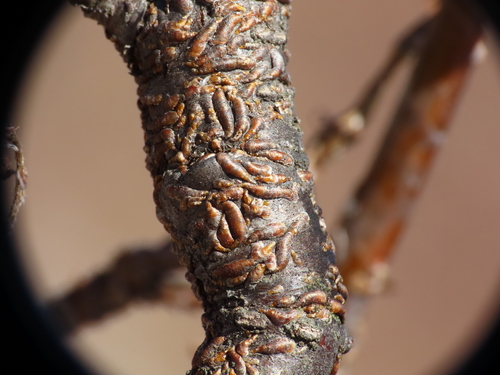
Oystershell Scale
Lepidosaphes ulmi
Hidden in plain sight on the bark of your favorite trees, the Oystershell Scale is a marvel of natural camouflage. These tiny, armor-clad insects build their own miniature fortresses, living out their entire lives as part of the tree's landscape.
Quick Identification
Size
Adult females are approximately 2-3 mm (0.08-0.12 inches) long; males are smaller and rarely observed.
Colors
Varies from grayish-brown to dark purple-brown, often mimicking the color and texture of the host tree's bark.
Key Features
- Elongated shape resembling a miniature oyster or mussel shell
- Hard, waxy protective covering
- Usually found in dense, crust-like clusters on branches
- Sessile (immobile) lifestyle as adults
When You’ll See Them
Behavior
The Oystershell Scale is a master of stationary survival. Once a young female crawler finds a suitable spot on a host tree, she inserts her long, thread-like mouthparts into the bark and never moves again. She spends her entire life under a protective waxy shell that she secretes, which toughens into a shield against predators and weather. These insects are often overlooked because they blend perfectly with the bark, appearing more like a natural deformity or a splash of dried mud than a living animal.
Despite their lack of movement, they are highly impactful members of the backyard ecosystem. They feed by sucking the nutrient-rich sap from woody plants, which can cause significant stress to the host. In a fascinating display of biological timing, the eggs overwinter under the dead mother's shell, hatching in late spring into tiny, mobile 'crawlers.' These crawlers are the only phase that explores the world, moving to new branches or being carried to different trees by the wind or on the feet of visiting birds.
EverydayEarth exclusive
Camera Tips
Capturing the Oystershell Scale requires a specialized approach because of their minute size and lack of movement. To get a clear shot, you must use a camera with high-quality macro capabilities or a dedicated macro lens. Position your camera extremely close to the bark of a known host plant—lilacs and apple trees are prime targets. Because these insects are only a few millimeters long, a distance of 3 to 6 inches from the subject is usually necessary. If your AI-powered camera has a digital zoom feature, ensure it is set to its highest resolution to maintain detail in the shell's texture.
Lighting is the most critical factor when filming Oystershell Scale. Because their shells are designed to blend in with bark, flat light will make them disappear. Use side-lighting—either from the early morning sun or an external LED light positioned at a 45-degree angle to the branch. This creates tiny shadows that highlight the raised, 'mussel-shell' ridges of the insect, making them pop against the flatter surface of the wood. Avoid using a direct, front-facing flash, as the waxy coating on the scale can cause harsh reflections that obscure identification features.
While the adults are stationary, you can capture incredible activity by setting your camera to time-lapse mode during the 'crawler' emergence in late spring. This usually occurs when lilacs are in full bloom. A time-lapse over 2 to 3 hours during a warm morning will reveal the incredible sight of thousands of tiny yellow specks emerging from the shells and dispersing across the bark. Ensure your tripod is weighted down or the camera is clamped firmly to the tree to prevent even the slightest vibration, which can ruin a macro shot.
Don't just focus on the scales themselves; use your camera to document the broader ecological story. If you leave your camera on a heavily infested branch for several hours during a summer afternoon, you are likely to capture their natural enemies. Look for the Twice-stabbed Lady Beetle (a black beetle with two red spots) or tiny parasitic wasps. These predators provide a dynamic element to your footage, showing the natural checks and balances occurring in your backyard's micro-wildlife scene.
Similar Species
Species that look similar or are commonly confused with Oystershell Scale.
Frequently Asked Questions
Record Oystershell Scale at your habitat
Connect a camera to start building your own species record — AI identifies every visitor automatically.