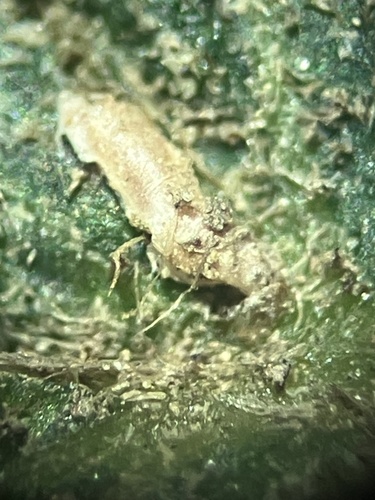
Scurfy Scale
Chionaspis furfura
The Scurfy Scale is a tiny architect of the backyard, building protective white armor that can coat the branches of fruit trees. Though small, these armored insects tell a fascinating story of survival and transformation right under our noses.
Quick Identification
Size
Females are 2–3 mm (0.08–0.12 in) long; males are significantly smaller at approximately 1 mm (0.04 in).
Colors
Females are dirty white or grayish with a yellowish-orange spot at the narrow end; males are pure white and narrow.
Key Features
- Broad, pear-shaped or fan-shaped female shell
- Pure white, elongated male scales with three distinct ridges
- Textured, 'scurfy' appearance that looks like white crust or scales on bark
When You’ll See Them
Behavior
Scurfy Scale insects are masters of stationary living. Unlike many insects that buzz or crawl through your garden, the adult female Scurfy Scale spends her entire life fixed to a single spot on a tree's bark. After settling as a 'crawler' in late spring, she secretes a hard, waxy, pear-shaped shield that protects her while she feeds on the tree's internal juices. These insects are often found in large colonies, creating a crusty, 'scurfy' texture that can eventually cover entire branches.
While the females are immobile, the males undergo a complete transformation. After developing under their own smaller, more linear white shields, they emerge as tiny winged insects whose sole purpose is to find and fertilize the females. To the average backyard observer, they appear as nothing more than a splash of white paint or a bit of fungal growth, but they are a complex part of the local ecosystem, providing a food source for ladybugs and parasitic wasps.
EverydayEarth exclusive
Camera Tips
Capturing the Scurfy Scale on camera requires a specialized approach because they are extremely small and mostly stationary. Standard backyard cameras won't see them unless they have a dedicated macro mode or an external macro lens attachment. Focus your camera on the trunk or lower branches of host trees like Apple, Pear, or Hawthorn. Look for areas that look 'dusty' or have white, crusty patches—this is where the colony is most dense.
To see any actual movement, you should set your camera to a time-lapse mode during the late spring (usually May or June). This is when the 'crawlers' (the mobile nymphs) emerge from under the mother's scale. They are tiny orange or pink specks. A time-lapse over a 4-hour window during a sunny afternoon can reveal a surprisingly busy world of movement that the naked eye usually misses. Positioning the camera about 4–6 inches from the bark is ideal for macro-capable units.
Lighting is your best friend when filming these insects. Because their scales are white and somewhat reflective, direct mid-day sun can wash out the detail. Try to capture them during 'golden hour' or use a diffused LED light source to bring out the ridges on the male scales and the pear-shape of the females. If you are using a trail camera, look for one with a very close focal minimum or use a clip-on magnifying lens to turn your standard sensor into a microscope.
Similar Species
Species that look similar or are commonly confused with Scurfy Scale.
Frequently Asked Questions
Record Scurfy Scale at your habitat
Connect a camera to start building your own species record — AI identifies every visitor automatically.