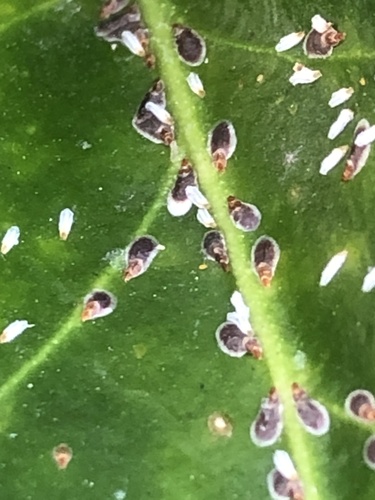
Euonymus Scale
Unaspis euonymi
Tiny but transformative, the Euonymus Scale is a master of camouflage that can encrust entire garden shrubs. Discover the hidden life of these armored insects and the 'crawlers' that drive their spread.
Quick Identification
Size
Females: 1.5–2.2 mm (0.06–0.09 in); Males: 0.8–1.0 mm (0.03–0.04 in)
Colors
Females are dark grayish-brown and pear-shaped; Males are smaller, narrow, and bright white
Key Features
- Oystershell-shaped dark brown females
- Linear white-colored males
- Yellow spots (chlorosis) on upper leaf surfaces
- Dense clusters on stems and leaf undersides
When You’ll See Them
Geographic range
Where Does the Euonymus Scale Live?
Originally native to East Asia, including China, Japan, and the Korean Peninsula, the Euonymus Scale has become a cosmopolitan traveler. It is now a widespread resident throughout much of North America, particularly across the eastern and central United States and parts of southern Canada. It has also established significant populations across Europe, from the United Kingdom to the Mediterranean, following the global trade of ornamental shrubs.
Basemap © OpenStreetMap contributors
Behavior
The Euonymus Scale is a sedentary armored scale insect that spends most of its life firmly attached to its host plant. Unlike many insects you might find in your backyard, the adult females are completely immobile, lacking legs or wings. They secrete a hard, waxy protective cover under which they feed and lay eggs. The only time this species is truly active is during the 'crawler' stage, when newly hatched nymphs move short distances to find a fresh spot to settle.
These insects are social only in their density; they often colonize a plant so heavily that the stems appear entirely encrusted with white and brown shells. This heavy feeding pressure can severely weaken or even kill the host plant. While they are considered a pest by gardeners, they represent a complex microcosm of backyard life, often attracting specialized predators like lady beetles and parasitic wasps that help keep their populations in check.
EverydayEarth exclusive
Camera Tips
Capturing the Euonymus Scale on camera requires a different approach than filming birds or mammals. Because these insects are microscopic and largely immobile, standard motion-trigger trail cameras will not detect them. To successfully document them, you will need a dedicated macro lens or a high-quality smartphone macro attachment. Focus your camera on the undersides of leaves or along the woody stems of Euonymus shrubs, where the white, needle-like males are most visible against the dark bark.
The most exciting footage you can capture is the emergence of the 'crawlers' (the mobile nymphs). In temperate climates, this usually happens in late spring (May or June) and again in mid-summer. Set your camera on a tripod for a high-magnification time-lapse over several hours on a warm, sunny morning. Look for tiny, orange-yellow dots moving slowly across the leaf surface; these are the only mobile stages of the insect's life.
Lighting is critical for clear identification. Use a ring light or a diffused side-light to highlight the texture of the female scales, which look like tiny oyster shells. Avoid harsh, direct midday sun, which can wash out the bright white color of the males. If you are using an AI-powered backyard camera, try placing it as close as the focal length allows to a heavily infested branch to monitor the activity of natural predators, such as the tiny Chilocorus lady beetles, which often visit scale colonies to feast.
Similar Species
Species that look similar or are commonly confused with Euonymus Scale.
Oystershell Scale
While similar in shape to the female Euonymus scale, it typically infests a wider range of trees (like maple or ash) and lacks the white-colored males.
White Peach Scale
Females are more circular and white-to-gray, often with a yellow or reddish center point, unlike the dark brown Euonymus female.
Frequently Asked Questions
Record Euonymus Scale at your habitat
Connect a camera to start building your own species record — AI identifies every visitor automatically.