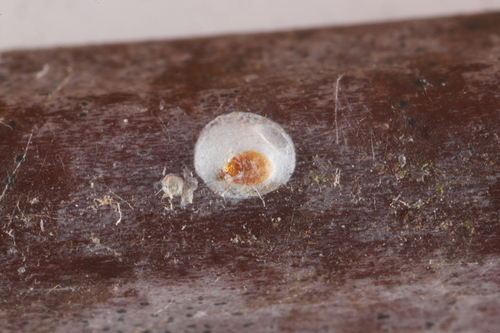
White Peach Scale
Pseudaulacaspis pentagona
Often mistaken for a splash of white paint or a dusting of snow, the White Peach Scale is a master of camouflage and colonizing. These tiny armored insects create complex, stationary societies right on the bark of your backyard fruit trees.
Quick Identification
Size
Females are 1.5–2.0 mm (0.06–0.08 in) in diameter; males are smaller and narrower, roughly 0.7 mm (0.03 in) long.
Colors
Females have a white to grayish-white circular cover with a yellow or orange center; males are bright white and elongated.
Key Features
- Circular female armor with an off-center yellow/orange 'nipple'
- Elongated, felt-like white male covers found in clusters
- Dense, crusty appearance on bark resembling white paint or snow
- Tiny, mobile orange 'crawlers' visible under magnification
When You’ll See Them
Behavior
The White Peach Scale is a fascinating example of extreme sexual dimorphism and a sedentary lifestyle. Once a female crawler finds a suitable spot on a host plant, she inserts her mouthparts to feed on sap and never moves again. She secretes a hard, waxy, circular shell that protects her as she grows and eventually lays eggs. To the naked eye, a heavy infestation looks like a thick, white crust on the bark of the tree, which can eventually lead to branch dieback or the death of the plant if left unchecked.
Males follow a completely different life path. After an initial sedentary feeding period under an elongated white cover, they undergo a pupal-like stage and emerge as tiny, two-winged insects that lack mouthparts. Their sole purpose in their short adult life—often lasting only a few hours—is to fly and locate a female for mating. They are most active during the warmer months, with two to four generations occurring per year depending on the local climate.
EverydayEarth exclusive
Camera Tips
Capturing the White Peach Scale requires a specialized approach because of their minuscule size. Standard trail cameras will not be able to resolve individual insects; instead, you need a camera with a macro lens or a very short minimum focus distance. If your AI-powered backyard camera supports macro attachments, clip one on and position the camera between 2 and 4 inches from an infested branch. This allows you to see the intricate 'fried egg' appearance of the female armor and the fuzzy texture of the male colonies.
To see the scale 'in action,' focus your efforts on the 'crawler' stage. These are the newly hatched nymphs that move across the bark. In many regions, this happens in late May or early June. Use a time-lapse setting on your camera, taking one photo every 60 seconds. When played back, the seemingly frozen white crust will appear to shimmer and flow as thousands of tiny orange dots migrate across the surface of the wood. This is the only time the species shows significant movement.
Lighting is your biggest challenge when photographing these insects. Their white waxy covers are highly reflective and easily 'blow out' in direct sunlight, losing all detail. Place your camera on the shaded side of the tree or use a piece of cardboard to create a shadow over the subject area. If your camera has a built-in ring light or LED, use it to create even, flat lighting that highlights the texture of the scale without creating harsh glares. Check your camera's exposure settings and turn the brightness down slightly if the white scales appear as solid white blobs.
Finally, consider the seasonal cycles for the best variety. In late summer, you may catch the emergence of the winged males. They look like tiny white gnats hovering around the densest parts of the colony. Using a high-speed video mode (60fps or higher) can help you slow down the footage enough to see these microscopic aviators as they dance around the stationary females. This provides a rare glimpse into a hidden world of insect reproduction that most gardeners miss entirely.
Similar Species
Species that look similar or are commonly confused with White Peach Scale.
Frequently Asked Questions
Record White Peach Scale at your habitat
Connect a camera to start building your own species record — AI identifies every visitor automatically.