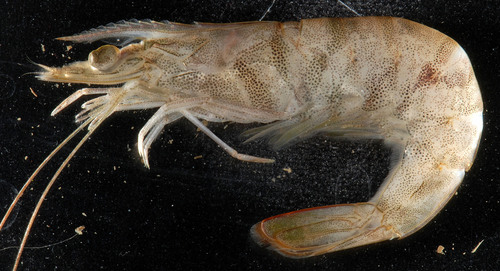
Pink Shrimp
Penaeus duorarum
The 'Pink Gold' of the Gulf, this translucent crustacean is a master of disguise and a nocturnal engine of the coastal ecosystem.
Quick Identification
Size
Total length of 10-20 cm (4-8 inches); typically weighs between 25-50 grams (0.8-1.7 oz).
Colors
Translucent pink to reddish-brown; characterized by a distinctive dark 'thumbprint' spot on each side of the abdomen.
Key Features
- Dark circular spot on both sides of the 3rd abdominal segment
- Deep grooves running along the top of the head and tail
- Long antennae often twice the length of the body
- Tail fins often edged with bright blue or purple iridescent highlights
When You’ll See Them
Geographic range
Where Does the Pink Shrimp Live?
Native to the Western Atlantic Ocean, the Pink Shrimp is found most abundantly along the southeastern coast of the United States and throughout the Gulf of Mexico. Its core range extends from the Chesapeake Bay southward around the Florida peninsula to the Yucatan Peninsula, reaching as far south as the coast of Brazil. These shrimp are particularly concentrated in the nutrient-rich, shallow waters of the Florida Keys and the Everglades, which serve as critical nursery grounds.
Basemap © OpenStreetMap contributors
Behavior
Pink Shrimp are primarily nocturnal scavengers that exhibit a fascinating 'duality' in their lifestyle. During the day, they remain completely buried in the seafloor, using their specialized legs to kick sand over their backs until only their eyes are visible. This burrowing behavior is a vital defense mechanism against the many predators, including snapper and seatrout, that hunt the shallow waters they call home.
As night falls, these shrimp emerge to forage across the bottom. They are highly active and sensitive to lunar cycles, often showing increased movement during the new and full moons. While they are not social in the sense of cooperative behavior, they are often found in massive aggregations, particularly during their seasonal migrations from inland estuaries out to deeper offshore spawning grounds. When threatened, they utilize a powerful 'tail-flip' response, snapping their abdomen to rocket backward away from danger.
EverydayEarth exclusive
Camera Tips
To capture Pink Shrimp on camera, you will need an underwater setup. If you live on a coastal canal or have access to a dock, the most effective method is to mount an action camera or a specialized underwater trail camera to a dock piling about 1 to 2 feet above the seabed. Ensure the camera is angled downward at roughly 45 degrees to capture the shrimp as they emerge from the sand at dusk. Because they are nocturnal, external lighting is a requirement; a steady, low-intensity green or white LED light is highly recommended as it attracts the shrimp without startling them.
Setting your camera to a high frame rate (at least 60 frames per second) is critical. Pink Shrimp are famous for their lightning-fast 'tail-flip' escape maneuver; at lower frame rates, this movement often appears as a blur or the shrimp simply disappears from the frame between shots. If your camera supports AI triggering, set the sensitivity to high, as their translucent bodies and thin antennae can sometimes be difficult for standard motion sensors to detect against a sandy background.
For the best 'action' shots, place a small mesh bait bag filled with crushed oily fish or shrimp pellets directly in the center of the camera's field of view. This encourages the shrimp to stay in front of the lens for longer periods as they pick at the food. Be mindful of the tides; the best footage is typically captured during the incoming tide at night when water clarity is at its peak and the shrimp are most active. After heavy rains, the water may become too murky for good captures, so wait for a string of calm, dry days for the clearest results.
Similar Species
Species that look similar or are commonly confused with Pink Shrimp.
Frequently Asked Questions
Record Pink Shrimp at your habitat
Connect a camera to start building your own species record — AI identifies every visitor automatically.