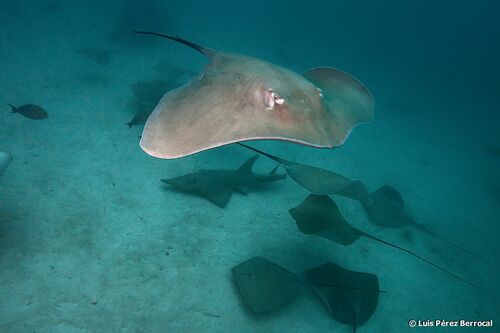
Pink Whipray
Pateobatis fai
A majestic resident of tropical reefs, the Pink Whipray is easily identified by its soft pastel hues and a tail that seems to go on forever. This gentle giant offers a mesmerizing glimpse into the hidden world of the Indo-Pacific seafloor.
Quick Identification
Size
Disc width up to 1.8 m (5.9 ft); total length including tail can exceed 5 m (16.4 ft)
Colors
Uniform brownish-pink to grayish-pink across the dorsal surface; tail becomes much darker, often near-black, past the venomous sting.
Key Features
- Broad diamond-shaped pectoral disc wider than it is long
- Exceptionally long, whip-like tail without any fin folds
- Uniform pinkish or brownish coloration without spots or patterns
- Broad-angled snout with a relatively smooth back featuring only a few small thorns
When You’ll See Them
Geographic range
Where Does the Pink Whipray Live?
The pink whipray is widely distributed across the tropical Indo-Pacific, stretching from the eastern coast of South Africa and the Red Sea across to the islands of Polynesia. It is a common sight in the warm coastal waters of Australia, Indonesia, the Philippines, and the Maldives. While it covers a vast geographic area, it remains a coastal specialist, rarely found in the open ocean or at depths exceeding 70 meters.
Basemap © OpenStreetMap contributors
Behavior
The pink whipray is a graceful bottom-dweller that spends much of its time gliding over sandy flats or resting partially buried in the substrate near coral reefs. While often solitary, they are known to congregate at 'cleaning stations' where small fish remove parasites from their skin, or in areas where food is abundant. They exhibit high site fidelity, meaning individuals often return to the same specific patch of reef or lagoon day after day.
When foraging, these rays use a 'shoveling' motion with their pectoral fins to uncover buried prey, creating noticeable pits in the sand. Despite their large size and intimidating whip-like tail, they are generally shy and non-aggressive toward humans, preferring to keep a respectful distance. However, they are equipped with a venomous spine at the base of the tail, which is used strictly as a defensive weapon against predators like hammerhead sharks.
EverydayEarth exclusive
Camera Tips
Capturing high-quality footage of a pink whipray requires an underwater camera setup, ideally mounted to a fixed structure like a private dock, pier piling, or a weighted reef stand. For backyard enthusiasts with coastal property, placing the camera 1 to 2 meters deep in a sandy-bottomed area near a reef edge is most effective. Ensure the camera is angled downward at roughly 30 degrees to capture the ray’s dorsal patterns and its incredibly long tail as it glides by.
Because these rays are most active as the tide rises and during low-light hours, use a camera with excellent infrared (IR) capabilities or a low-light sensor. Avoid using bright white-light strobes, which can spook the animal. Setting your camera to record longer video clips (30-60 seconds) is highly recommended; because the pink whipray can be over 5 meters long, a short 5-second clip might only capture the snout and miss the spectacular whip-tail entirely.
Maintenance is key when monitoring marine life. In tropical waters, algae and barnacles can coat a camera lens in a matter of days. Use a specialty anti-fouling lens coating or plan for weekly cleaning. If you are baiting the area to attract crustaceans (which in turn attract the rays), place the lure in a perforated container to prevent the rays from damaging your equipment while trying to feed.
Similar Species
Species that look similar or are commonly confused with Pink Whipray.
Frequently Asked Questions
Record Pink Whipray at your habitat
Connect a camera to start building your own species record — AI identifies every visitor automatically.