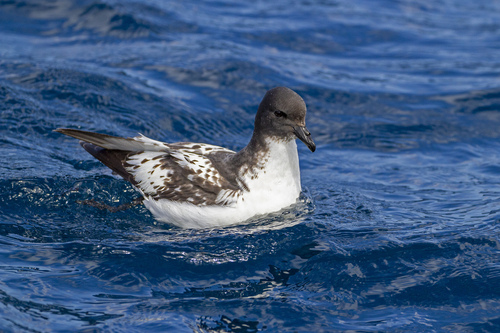
Pintado Petrel
Daption capense
Meet the 'Cape Pigeon' of the southern seas, a bold voyager famous for its striking checkerboard wings and fearless attitude. Whether following ships or nesting on icy cliffs, the Pintado Petrel is a true icon of the Southern Ocean.
Quick Identification
Size
Length: 35–42 cm (14–17 in); Wingspan: 80–91 cm (31–36 in); Weight: 430–480 g (15–17 oz)
Colors
Bold black and white 'checkerboard' pattern on the back and wings; solid sooty-black head; white underparts; black bill and feet. Both sexes share identical plumage.
Key Features
- Distinctive black-and-white mottled 'checkerboard' upperparts
- Sooty-black head and throat contrasting with white breast
- Two large white patches on the upper surface of each wing
- Square tail with a prominent black terminal band
When You’ll See Them
Behavior
Pintado Petrels, affectionately known by sailors as 'Cape Pigeons,' are among the most social and gregarious seabirds of the Southern Ocean. They are famously bold, frequently following ships for miles to scavenge scraps from the wake or feed on organisms churned up by propellers. In the water, they often gather in large, floating groups called 'rafts,' where they engage in noisy, chattering social interactions.
These birds are surprisingly aggressive when it comes to food. During feeding frenzies, they emit a high-pitched cackling sound and will fiercely defend a find against other birds. When threatened at their nesting sites on rocky cliffs, they utilize a unique defense mechanism common to the petrel family: spitting a foul-smelling, orange stomach oil at intruders. Despite this feisty nature, they are graceful flyers, alternating between rapid wingbeats and long, elegant glides close to the ocean surface.
EverydayEarth exclusive
Camera Tips
Capturing a Pintado Petrel on an AI-powered camera requires a specific coastal strategy, as these birds are rarely found far from the spray of the ocean. If you are located in a coastal region of the Southern Hemisphere—such as the southern coasts of New Zealand, Australia, or South America—position your camera on a high vantage point overlooking the sea. Coastal cliffs, rocky outcroppings, or even a sturdy pier are ideal. Because these birds are drawn to the movement of the water, an angle that captures both the horizon and the immediate shoreline is most effective.
One of the best ways to lure a Pintado Petrel into range is to take advantage of their scavenging nature. If local regulations allow, placing a small amount of fresh fish scraps on a flat, rocky ledge can attract them for a close-up 'portrait.' Set your camera at a height of 2 to 4 feet, angled slightly downward. Be extremely mindful of the environment; use a weather-sealed camera housing or a protective 'hide' to shield your gear from the corrosive effects of salt spray, which can damage standard electronics within hours.
For the best visual results, focus on the 'golden hours' of the early morning and late afternoon. The low-angle sunlight highlights the intricate white patches on their wings, which can otherwise look washed out in the harsh midday sun. Set your camera to 'Burst Mode' or a high-speed shutter setting; Pintado Petrels are incredibly fast and erratic in flight, and a standard single-shot trigger may only capture a blurred wing or a tail. Using a camera with a wide-angle lens can also help capture the bird in the context of its dramatic oceanic environment.
Similar Species
Species that look similar or are commonly confused with Pintado Petrel.
Frequently Asked Questions
Record Pintado Petrel at your habitat
Connect a camera to start building your own species record — AI identifies every visitor automatically.