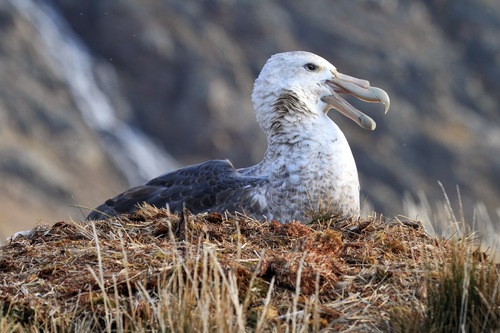
Southern Giant Petrel
Macronectes giganteus
The formidable 'Vulture of the Sea,' the Southern Giant Petrel is a massive ocean wanderer known for its seven-foot wingspan and bold, scavenging nature. A true icon of the wild southern coastlines, these birds are as powerful on land as they are in the air.
Quick Identification
Size
Wingspan of 150 to 210 cm (4.9 to 6.9 ft); length 86 to 99 cm (34 to 39 in); weight 3.8 to 5 kg (8.4 to 11 lbs)
Colors
Mottled grey-brown body with a paler head and neck; roughly 10% are a rare 'white morph' which is entirely white with scattered black feathers. The bill is straw-colored with a distinct greenish tip.
Key Features
- Massive, pale bill with a prominent 'tube-nose' and greenish tip
- Huge wingspan with long, narrow wings typical of petrels
- Hunched, powerful stance when standing on land
- Large, dark eyes that contrast against a paler face
When You’ll See Them
Sightings on EverydayEarth
May 4, 2026
Numerous Southern Giant Petrels are seen resting across the rocky landscape of Isla Gran Robredo. While most of the colony remains tucked low to the ground, one bird in the mid-ground stands up to fully extend its wings before readjusting its position.
May 2, 2026
A vast colony of Southern Giant Petrels is spread across the rocky terrain of Isla Gran Robredo. The majority of the birds are resting on the ground, with several individuals seen preening their feathers or turning their heads. A few Kelp Gulls are interspersed throughout the colony. In the middle of the sequence, a single petrel is observed flying across the upper portion of the frame from right to left.
Apr 24, 2026
A vast colony of Southern Giant Petrels covers the landscape, with numerous birds resting on the ground. Many individuals can be seen turning their heads and adjusting their positions across the hazy field, indicating active colony attendance.
Apr 23, 2026
A vast colony of Southern Giant Petrels is spread across a rocky, coastal landscape. Dozens of birds are seen resting or nesting on the ground, with some individuals turning their heads or shifting position in the bright afternoon sun. In the distance, the colony extends toward the blue waters of the Atlantic Ocean.
Apr 21, 2026
A large colony of Southern Giant Petrels is scattered across a rocky, arid landscape. Many birds are seen resting on the ground, occasionally preening or shifting their positions. Strong gusts of wind kick up clouds of dust and sand that swirl across the colony. Several birds are also seen soaring through the air in the background.
Apr 21, 2026
A large colony of Southern Giant Petrels is spread across a rocky nesting ground near the coast. Many birds are seen resting or sitting in nesting hollows. In the foreground, a single petrel is particularly visible as it turns its head to observe its surroundings.
Behavior
Southern Giant Petrels are the undisputed 'vultures of the sea.' While most petrels are graceful ocean-dwellers, these birds are equally formidable on land, using their powerful legs to walk and even run across rocky shores or ice. They are highly opportunistic and often aggressive, especially when competing for food. You will often see them with their wings partially spread in a 'threat display' to ward off other birds from a carcass.
Socially, they are fascinating to watch at breeding colonies, where they form long-term pair bonds. Unlike many other seabirds, they are quite bold around humans in coastal environments, though they are famous for their defense mechanism: they can spit a foul-smelling stomach oil at perceived threats, which gives them the nickname 'Stinkpot.'
EverydayEarth exclusive
Camera Tips
To capture the majesty of a Southern Giant Petrel on your wildlife camera, location is everything. If you live in a coastal area within their southern range, focus your efforts on rocky outcroppings or beach-fronts where kelp and sea debris wash up. These birds are scavengers by nature, so they are drawn to areas where the tide brings in potential meals. Position your camera on a sturdy tripod or mount it low to the ground—about 18 to 24 inches high—to get an eye-level perspective of their powerful gait as they walk across the shoreline.
Because they are large birds, wide-angle lenses are preferred to capture their full wingspan if they take flight near the camera. If you are using a trigger-based camera, set the sensitivity to high and the burst mode to at least 3-5 photos. Their movements can be deceptively fast, especially when they are squabbling over food or taking off into the wind. If your camera allows for video, 60fps is ideal to capture the fluid motion of their massive wings.
Lighting can be tricky on the coast. Try to position the camera with the sun at your back to highlight the subtle mottled patterns of their plumage and the characteristic green tip of their bill. Avoid pointing the camera directly at the bright ocean to prevent silhouetting. While we never recommend baiting wild animals with processed food, placing a camera near natural occurrences like a washed-up fish or near a known penguin colony (from a respectful distance) will significantly increase your chances of a close-up encounter.
Finally, remember that these birds are most active when the wind is up. High-wind days provide the lift they need to soar effortlessly. Secure your camera housing extra tightly, as coastal winds can be brutal. If you are lucky enough to spot a white-morph individual, ensure your exposure settings are dialed back slightly to prevent blowing out the highlights on their snowy feathers.
Similar Species
Species that look similar or are commonly confused with Southern Giant Petrel.
Frequently Asked Questions
Record Southern Giant Petrel at your habitat
Connect a camera to start building your own species record — AI identifies every visitor automatically.