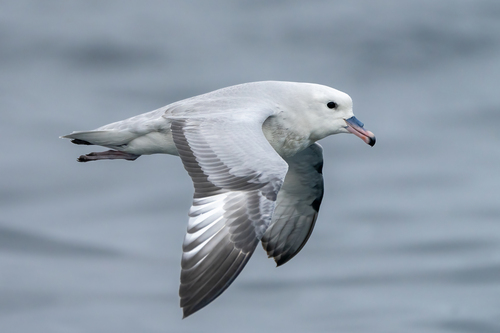
Southern Fulmar
Fulmarus glacialoides
The silver-winged sentinel of the Southern Ocean, the Southern Fulmar is a master of the Antarctic winds. With its striking tubular nose and fearless personality, this resilient seabird thrives where few others can survive.
Quick Identification
Size
Length: 45–50 cm (18–20 in); Wingspan: 110–120 cm (43–47 in); Weight: 700–1,000 g (1.5–2.2 lbs)
Colors
Pale silver-grey upperparts with white underparts and head; dark primary wing tips; pinkish bill with a blue tube and dark tip.
Key Features
- Prominent tubular nostrils (tubenose) on top of bill
- Stiff-winged flight pattern with shallow wingbeats
- Distinctive silver-grey mantle and white underparts
- Stocky, powerful build for oceanic gliding
When You’ll See Them
Behavior
The Southern Fulmar is a gregarious and bold seabird, known for its incredible mastery of wind currents. Unlike many other petrels that are shy around humans, Southern Fulmars are notorious ship-followers, often trailing fishing vessels for miles to scavenge for offal. They are highly social, nesting in vast, noisy colonies on Antarctic and sub-Antarctic cliffs where they engage in cackling displays and bill-fencing with mates.
One of their most fascinating behaviors is their defense mechanism. When threatened, particularly at the nest, they can accurately project a stream of foul-smelling, orange stomach oil from their mouths. This oil is not just a chemical deterrent; it is physically dangerous to other birds as it destroys the waterproofing of their feathers. In their social circles, they are quite aggressive, often squabbling loudly over food sources at the ocean's surface.
EverydayEarth exclusive
Camera Tips
Capturing the Southern Fulmar on camera is a unique challenge because they rarely venture onto flat land. If you are setting up a camera near a coastal overlook or a known breeding colony in the Southern Ocean, the most effective placement is on a cliff edge facing the wind. These birds are 'slope-soarers,' meaning they use the updrafts created by wind hitting the cliffs to stay aloft. Position your camera at a 45-degree angle to the horizon to capture both their aerial acrobatics and the dramatic coastal backdrop.
For those using AI-powered cameras on marine vessels or coastal stations, the fast motion of these birds requires specific settings. Ensure your camera is set to a high shutter speed or 'action mode.' Because the Southern Fulmar has bright white underparts, they can easily 'wash out' in high-contrast environments like snow or reflective water. We recommend setting your exposure compensation to -0.5 or -1.0 to preserve the fine details in their feathers. If your camera allows for zone focusing, set it to a medium distance (10-20 feet) where the birds are most likely to glide past the cliff face.
Baiting is generally discouraged in wildlife photography, but these birds are naturally attracted to the scent of fish oil. While you shouldn't put out food, placing a sponge soaked in fish oil in a perforated container near the camera (out of reach of the bird) can draw them in to investigate the scent. This is particularly effective during the breeding season (October–March) when they are actively foraging for their chicks. At night, they are less active, so focus your monitoring during the golden hours when the low sun highlights the silver sheen of their wings.
Finally, consider the extreme weather of their habitat. If you are leaving a trail camera out near a colony, use a high-quality protective housing and ensure the mount is bolted or heavily weighted. The Southern Fulmar lives in some of the windiest places on Earth, and a standard tripod will likely be blown over. Use a high-capacity SD card and set your camera to burst mode, as these birds move quickly and you’ll want a sequence of frames to ensure at least one has the eyes in sharp focus.
Similar Species
Species that look similar or are commonly confused with Southern Fulmar.
Frequently Asked Questions
Record Southern Fulmar at your habitat
Connect a camera to start building your own species record — AI identifies every visitor automatically.