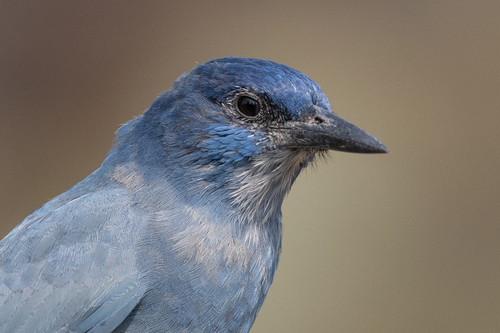
Pinyon Jay
Gymnorhinus cyanocephalus
The Pinyon Jay is the brilliant blue socialite of the West, known for its incredible intelligence and massive, boisterous flocks. Unlike its solitary cousins, this crestless jay moves like a blue wave through the foothills, remembering the location of every seed it hides.
Quick Identification
Size
Length: 26–29 cm (10–11 in); Wingspan: 45–50 cm (18–20 in); Weight: 90–120 g (3.2–4.2 oz)
Colors
Overall dusty blue with a slightly darker head; whitish throat with faint blue streaking; black bill and legs; no significant color difference between males and females.
Key Features
- Uniform dull blue plumage without a crest
- Long, sharp, dagger-like bill
- Notably short tail for a jay
- Highly social behavior, usually appearing in large, vocal flocks
When You’ll See Them
Behavior
Pinyon Jays are among the most social birds in North America, living in permanent, complex flocks that can range from a few dozen to several hundred individuals. Unlike many other jays that are territorial, Pinyon Jays are nomadic and communal, often nesting in colonies and traveling together to find food. They are famous for their intelligence and spatial memory, as a single bird can cache tens of thousands of pinyon pine seeds in the ground and relocate them with incredible accuracy months later.
In a backyard setting, they are rarely seen alone. If you hear a series of nasal, high-pitched 'kaw' calls, a flock is likely nearby. They are bold and communicative, using a wide range of vocalizations to coordinate movement and alert the group to predators. Their arrival at a feeder is usually a high-energy event, with birds constantly shuffling positions and filling their expandable throat pouches with as many seeds as possible before flying off to hide them.
EverydayEarth exclusive
Camera Tips
To capture high-quality footage of Pinyon Jays, the 'golden rule' is to account for their flocking nature. Instead of pointing your camera at a single perch, use a wide-angle setting or position the camera 6-10 feet back from a large platform feeder. These birds often descend in groups of 20 or more; a tight focus will only capture a blur of blue wings, while a wider shot captures the fascinating social hierarchies and 'crowding' behavior that defines the species.
Water is a massive draw for Pinyon Jays, especially in the arid Western climates they inhabit. If you have an AI camera near a birdbath, ensure the water is kept fresh and the basin is large enough for multiple birds. Position the camera at 'eye level' with the rim of the bath (roughly 3-4 feet high) and angle it slightly downward. This allows you to catch the detail of their whitish throats and sharp bills as they dip for a drink. Because they are thirsty travelers, a single visit to a water source can yield dozens of high-quality clips in a matter of minutes.
For baiting, Pinyon Jays are obsessed with high-fat snacks that they can cache. Whole, unsalted peanuts (in the shell) are irresistible to them. If you place a tray of peanuts out, your AI camera will likely trigger repeatedly as the birds engage in 'shuttling'—grabbing a nut, flying to a nearby tree to hide it, and immediately returning for another. Setting your camera’s 'Re-trigger Interval' to the shortest possible time (or using a continuous video mode) is essential to document this frantic caching behavior.
Don't neglect the ground! Pinyon Jays spend a significant amount of time foraging on the forest floor or on the ground beneath feeders. Placing a trail camera just 12-18 inches off the ground near a scattered handful of sunflower seeds can provide a unique perspective on their hopping gait and how they use their bills to probe the soil. This low angle is often the best way to distinguish them from other jays, as it highlights their stocky build and lack of a head crest.
Similar Species
Species that look similar or are commonly confused with Pinyon Jay.
Woodhouse's Scrub-Jay
Has a distinct gray back and white underparts, whereas the Pinyon Jay is blue nearly all over.
Steller's Jay
Possesses a very prominent black crest and a much darker, charcoal-colored head and neck.
California Scrub-Jay
Features a white 'necklace' and belly with a much longer tail than the Pinyon Jay.
Frequently Asked Questions
Record Pinyon Jay at your habitat
Connect a camera to start building your own species record — AI identifies every visitor automatically.