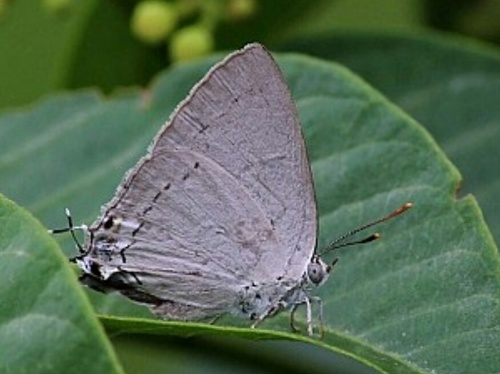
Plains Blue Royal
Tajuria jehana
A flash of sky-blue in the canopy, the Plains Blue Royal is a master of high-speed maneuvers and delicate beauty. With its elegant 'tails' and silvery wings, this butterfly is a prized visitor for any backyard observer.
Quick Identification
Size
Wingspan of 30–38 mm (1.2–1.5 inches)
Colors
Male: Brilliant sky-blue upperside with narrow black borders; Female: Paler grayish-blue with broader black margins. Both have silvery-grey undersides with fine black lines and orange-ringed spots near the tail.
Key Features
- Two delicate, hair-like tails on each hindwing
- Silvery-grey underside with a distinct wavy post-discal line
- Vibrant metallic blue upperside visible during flight
- Two orange-crowned black 'eyespots' at the base of the tails
When You’ll See Them
Behavior
The Plains Blue Royal is a fast and energetic flyer, often found darting through the canopies of trees. It is highly territorial; males are frequently observed perched on high leaves, acting as sentinels and chasing away any other butterflies that enter their space. They are particularly active during the warmest parts of the day when the sun is at its peak, using the heat to power their rapid, erratic flight patterns.
This species is deeply tied to parasitic plants, specifically mistletoes (Loranthus), which serve as the primary host for their larvae. In a backyard setting, they are most likely to be seen when they descend from the treetops to visit nectar-rich flowers or to 'puddle' on damp ground. Despite their royal name and brilliant colors, they can be quite elusive, relying on their drab, silvery underside to blend into the foliage when their wings are closed.
EverydayEarth exclusive
Camera Tips
Capturing the Plains Blue Royal requires a specialized setup because of their small size and tendency to stay high in the canopy. To bring them into camera range, place your AI-powered camera near flowering shrubs like Ixora, Lantana, or Buddleja (Butterfly Bush). These flowers act as a natural 'lure' that brings them down from the trees. Set your camera at a height of 3 to 5 feet, angled slightly upward toward the blossoms to catch the flash of blue as they arrive.
Because these butterflies move with incredible speed, your camera's motion trigger sensitivity should be set to 'High.' If your camera supports it, use a 'Pre-roll' or 'Burst' feature to ensure you catch the moment of landing; otherwise, you may only end up with a blur. A fast shutter speed (at least 1/1000s) is essential to freeze the delicate motion of their hair-like tails and the intricate patterns on their wings. High-resolution 4K video is also a great option, as it allows you to pull high-quality still frames from the footage later.
Lighting is the most critical factor for this species. The metallic blue on their wings only truly 'pops' in direct sunlight. Position your camera so the sun is behind it, illuminating the flower bed or perching branch. If you are struggling to see them, try creating a 'puddling station'—a shallow tray of damp sand mixed with a little sea salt. Males will often land here to drink minerals, providing a stationary target for your lens that lasts much longer than a quick nectar visit.
Lastly, consider the season. While they can be found year-round in warmer climates, sightings often peak just after the monsoon when mistletoe plants are lush. If you have a tree in your yard with visible mistletoe clusters (clumps of leaves that look different from the host tree), point a secondary camera at those branches, as you might capture the rare sight of females laying eggs or newly emerged adults drying their wings.
Similar Species
Species that look similar or are commonly confused with Plains Blue Royal.
Frequently Asked Questions
Record Plains Blue Royal at your habitat
Connect a camera to start building your own species record — AI identifies every visitor automatically.