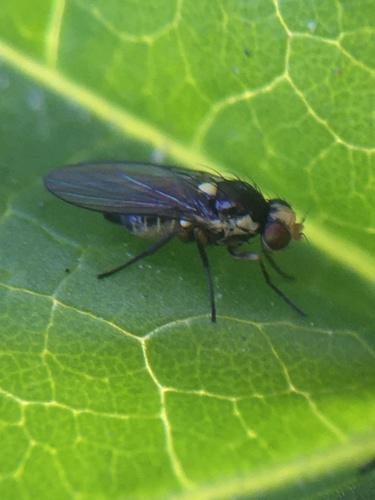
Potato Leaf Miner
Liriomyza huidobrensis
Though barely larger than a pinhead, the Potato Leaf Miner leaves its mark through intricate, winding white trails painted across garden leaves. This tiny black-and-yellow fly is a fascinating example of how some of nature's most destructive artists work from the inside out.
Quick Identification
Size
Adults are 1.5–2.3 mm (0.06–0.09 inches) long; wingspan is approximately 2 mm (0.08 inches).
Colors
Shiny black body with bright yellow markings on the face, sides, and a distinct yellow spot on the scutellum (upper back).
Key Features
- Tiny black body with a prominent bright yellow spot on the back
- Creates winding white 'serpentine' trails inside leaves
- Leaves tiny white puncture marks (stippling) on foliage surfaces
- Wings are clear with dark, well-defined veins
When You’ll See Them
Behavior
The Potato Leaf Miner is a master of stealth, with its life cycle largely occurring within the protective layers of a leaf. Adult females use their specialized egg-laying organs to puncture leaves, both to feed on the resulting plant sap and to deposit eggs. These 'stipples' are often the first sign of their presence, appearing as tiny white dots across the surface of garden vegetables. Once the larvae hatch, they begin their namesake 'mining,' tunneling through the middle layer of the leaf while leaving the outer skin intact to protect them from predators and the elements.
Unlike many insects that are solitary, these flies are often found in localized clusters wherever their favorite host plants are growing. They are highly adaptable and have developed resistance to many common pesticides, making them a formidable presence in both commercial agriculture and home vegetable gardens. While the adults are capable of flight, they are relatively weak fliers and often rely on wind currents or the movement of infested plants to reach new territories.
EverydayEarth exclusive
Camera Tips
Capturing the Potato Leaf Miner on camera is a unique challenge that requires a dedicated macro setup. Because these flies are roughly the size of a grain of pepper, standard trail cameras will likely only see them as moving specks. To get a high-quality ID, position your camera just 2 to 5 inches away from the leaves of known host plants like snap peas, spinach, or potatoes. Angle the camera slightly downward to capture the 'dorsal' (top) view of the fly, which is necessary to see the diagnostic yellow spot on its back.
Since these insects are biologically programmed to seek out the color yellow, you can use this to your advantage. Placing a small yellow card or even a yellow plastic lid near your target plant can act as a natural lure, encouraging the adults to land and remain still for a few moments. If you are using an AI-powered camera like those from EverydayEarth, ensure you are in a high-resolution mode. Good lighting is the most critical factor; bright but indirect sunlight provides the best contrast to highlight the black and yellow markings without washing out the image with glare from the leaf's waxy surface.
Don't just look for the flies—look for the mines. One of the most effective ways to use a trail camera with this species is to set up a time-lapse on an infested leaf. Over a period of 48 to 72 hours, you can record the fascinating progression of the white serpentine trails as the larvae move through the leaf. This provides a 'hidden' look at their life cycle that a single still photo could never capture. Peak activity usually occurs when temperatures are between 65°F and 80°F, so focus your monitoring on warm, calm afternoons.
Similar Species
Species that look similar or are commonly confused with Potato Leaf Miner.
Frequently Asked Questions
Record Potato Leaf Miner at your habitat
Connect a camera to start building your own species record — AI identifies every visitor automatically.