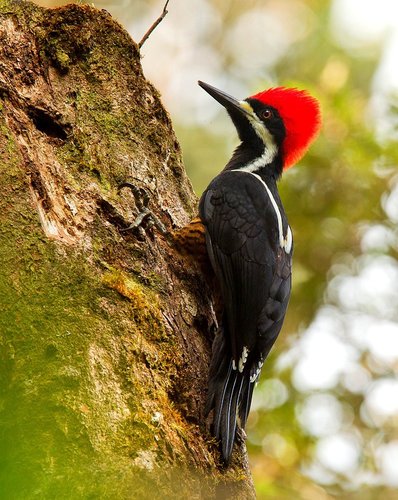
Powerful Woodpecker
Campephilus pollens
A high-altitude titan of the Andes, the Powerful Woodpecker commands attention with its vibrant red crest and thunderous drumming. This striking bird is a master of the cloud forest, carving out a living in the mist-shrouded canopy.
Quick Identification
Size
Length of 33 cm (13 inches); Weight approximately 230–255 g (8.1–9.0 oz)
Colors
Jet black back with a bold white 'V'; cream to cinnamon-buff underparts with dark horizontal barring. Males have a fully red crown and crest; females have a black forehead and crown with red limited to the rear crest.
Key Features
- Large, saturated red crest
- Bright white 'V' on a black back
- Ivory to pale-grey chisel-shaped bill
- Barred cinnamon underparts
When You’ll See Them
Geographic range
Where Does the Powerful Woodpecker Live?
Native to the South American continent, the Powerful Woodpecker is a quintessential bird of the high Andes. Its core range stretches through the montane forests of Colombia, Ecuador, and Peru, with smaller populations found in western Venezuela. These birds are specialized to live in the rugged, misty terrain of the cloud forest where they remain residents year-round without migrating.
Basemap © OpenStreetMap contributors
Behavior
The Powerful Woodpecker is a bird of strength and precision, living up to its name with loud, resonant drumming that can be heard across Andean valleys. They are typically found in pairs or small family groups, maintaining large territories in the cloud forest. Unlike some smaller woodpecker species that flit nervously, the Powerful Woodpecker moves with deliberate, heavy hitches up tree trunks, often pausing to listen for the movement of larvae beneath the bark.
These birds are highly specialized for life in the high-altitude mists. They communicate with a series of nasal calls and a characteristic 'double-tap' drum, which is common among the Campephilus genus. While they are generally shy around humans, they are bold in their foraging, often ignoring observers if they are deep into a particularly rewarding piece of decaying wood.
EverydayEarth exclusive
Camera Tips
To capture the Powerful Woodpecker, you must look higher than you would for most backyard species. If you live or are visiting a property in the Andean cloud forest zone, place your camera 10 to 15 feet up on a large, partially decaying 'snag' or dead tree. These birds prefer trees with significant girth and plenty of soft, rotting wood where beetle larvae are plentiful. Angle the camera slightly downward to capture the bird as it hitches its way up the trunk.
Baiting is rarely successful with this species as they are specialized insectivores, but you can increase your chances by identifying 'work trees'—trees with fresh, deep wood chips at the base and large rectangular holes in the bark. If you find a tree they are currently utilizing, mount your camera nearby. Because they are active in the misty, often dark cloud forest, use a camera with a high-quality sensor and fast trigger speed to avoid motion blur during their vigorous hammering.
Set your camera to video mode or burst photo mode. The double-tap drumming happens in a fraction of a second, and a single photo will likely miss the action. High-frame-rate video (60fps or higher) is ideal for capturing the incredible mechanics of their head and neck movement during excavation. If your camera has a 'time-lapse' feature that triggers on motion, set it to the morning hours when they are most vocal and active in their territory.
Similar Species
Species that look similar or are commonly confused with Powerful Woodpecker.
Frequently Asked Questions
Record Powerful Woodpecker at your habitat
Connect a camera to start building your own species record — AI identifies every visitor automatically.