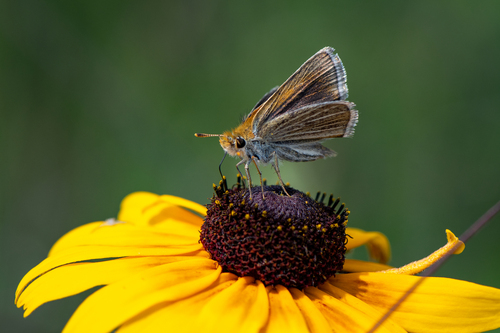
Poweshiek Skipperling
Oarisma poweshiek
A rare treasure of the American prairie, the Poweshiek Skipperling is a tiny flyer with a mighty story. Known for its striking silver-veined wings, this endangered butterfly is a true indicator of a healthy, wild landscape.
Quick Identification
Size
Wingspan of 24–30 mm (0.9–1.2 inches); total body length approx. 12–15 mm (0.5–0.6 inches).
Colors
Upper wings are dark brown with a warm orange-copper wash along the edges; underside of the hindwing is distinctive dark greyish-brown with prominent, contrasting white veins.
Key Features
- Distinctive white-lined veins on the underside of the hindwings
- Small, stout body with an orange-tinted head and thorax
- Rapid, erratic 'skipping' flight pattern
- Short antennae with slightly hooked clubs at the tips
When You’ll See Them
Behavior
The Poweshiek Skipperling is a highly specialized butterfly known for its quick, darting flight. Unlike some of the larger, more soaring butterflies, this species stays relatively low to the ground, weaving through tall prairie grasses. They are most active during the warmest parts of the day when the sun is high, as they rely on solar heat to fuel their high-energy flight patterns.
These butterflies are extremely sensitive to their environment and are considered a 'specialist' species. They don't migrate; instead, they spend their entire life cycle within a very small radius of their birth. Because they are critically endangered, sightings are rare and usually occur in high-quality, undisturbed native prairies or fens where their specific host plants thrive.
EverydayEarth exclusive
Camera Tips
Capturing a Poweshiek Skipperling on camera requires a focus on their favorite nectar sources. Because they are so small and move quickly, set your AI-powered camera or trail cam on a tripod just 12 to 24 inches away from a cluster of Black-eyed Susans or Prairie Smoke. Positioning the camera at a slightly upward angle from the ground will help capture the diagnostic white veins on the underside of their wings when they land to feed.
Since these butterflies are most active in bright sunlight, ensure your camera is positioned to avoid harsh glares while maintaining a high shutter speed. If your camera allows for manual settings, a shutter speed of at least 1/1000th of a second is ideal to freeze their rapid wing movement. Because of their endangered status, it is vital to never use physical lures or baits that could harm the local ecosystem; instead, planting a 'butterfly patch' of native Little Bluestem or Purple Coneflower is the best way to encourage a visit.
If you are using an AI-triggered camera, set the sensitivity to 'High' to account for their small size and rapid movement. Time-lapse mode can also be a secret weapon—set it to take a photo every 5-10 seconds during peak sunny hours (11 AM to 2 PM) in late June. This increases your chances of catching a frame during the brief moment the skipperling holds its wings still to feed. Always maintain a respectful distance to ensure you don't disturb their fragile habitat.
Similar Species
Species that look similar or are commonly confused with Poweshiek Skipperling.
Frequently Asked Questions
Record Poweshiek Skipperling at your habitat
Connect a camera to start building your own species record — AI identifies every visitor automatically.