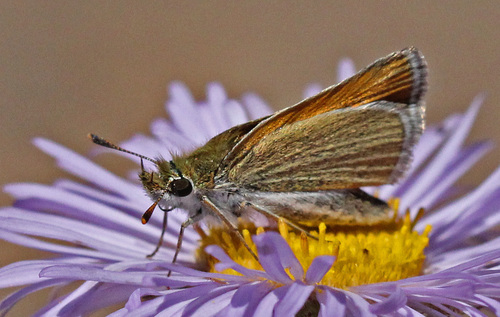
Garita Skipperling
Oarisma garita
A golden flash in the summer grass, the Garita Skipperling is a tiny marvel of the North American prairie. These sun-loving insects bring a touch of metallic brilliance to native meadows and wild suburban gardens.
Quick Identification
Size
Wingspan of 20 to 30 mm (0.8 to 1.2 inches)
Colors
Bright golden-orange to tawny upper wings with thin dark borders; undersides of hindwings are pale grayish-brown with distinct white veins.
Key Features
- Tiny, vibrant orange-gold wings
- Prominent white or silvery veins on the underside of hindwings
- Short antennae with blunt, club-like ends
- Low, darting flight pattern through tall grasses
When You’ll See Them
Behavior
The Garita Skipperling is a spirited little butterfly known for its erratic, 'skipping' flight pattern. Unlike many larger butterflies that glide gracefully, this species stays low to the ground, weaving through tall grass stems and frequently stopping to perch. When resting, they often hold their wings in a characteristic 'V' shape, a pose common to many skippers that helps them regulate their body temperature while remaining ready for a quick takeoff.
These butterflies are mostly solitary but may congregate in areas where their favorite nectar sources, such as purple prairie clover or fleabane, are abundant. They are sun-lovers and are rarely seen on overcast or cold days. For backyard observers, they are most easily spotted in the late morning when they are actively seeking nectar or searching for mates along the edges of grassy patches.
EverydayEarth exclusive
Camera Tips
Capturing the Garita Skipperling on camera requires a focus on micro-habitats. Because these butterflies rarely fly higher than a few feet off the ground, your camera should be mounted low—roughly 12 to 24 inches high. Aim your lens at 'landing pads' like the flowering tops of native grasses or nectar-rich wildflowers. If you have a patch of Blue Grama or Sideoats Grama in your yard, this is the ideal spot to station your equipment.
Standard trail cameras may struggle with the small size of a skipperling, so use a camera with a high-resolution sensor or a dedicated macro mode if available. If using a triggered camera, set the sensitivity to high and the shutter speed as fast as possible to freeze their rapid wing movements. To avoid the 'washed out' look on their bright orange wings, try to position your camera so the sun is behind you or to the side, rather than pointing directly into the light.
Timing is critical for this species. They have a very short flight window, often only lasting 3 to 4 weeks in early summer. Check your local phenology reports to know exactly when they emerge. Since they are cold-blooded and rely on the sun for energy, focus your recording efforts on bright, calm days. Even a moderate breeze can send these lightweight flyers into hiding deep within the grass thatch.
Similar Species
Species that look similar or are commonly confused with Garita Skipperling.
Frequently Asked Questions
Record Garita Skipperling at your habitat
Connect a camera to start building your own species record — AI identifies every visitor automatically.