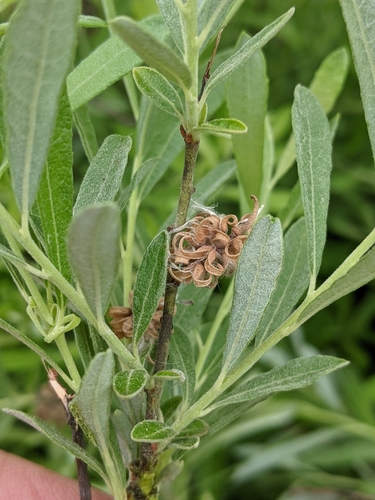
Prairie Willow
Salix humilis
A tough-as-nails survivor of the Great Plains, the Prairie Willow brings early spring life to dry landscapes with its iconic silver catkins. It’s not just a shrub—it's a bustling hub for the first bees and butterflies of the season.
Quick Identification
Size
Typically 0.6 to 3 meters (2 to 10 feet) in height with a similar spread
Colors
Sage-green to olive-drab foliage; silver-white fuzzy catkins; reddish-brown or gray bark on stems
Key Features
- Multi-stemmed, clump-forming growth habit
- Fuzzy, silvery catkins appearing before leaves in spring
- Lance-shaped leaves with velvety, pale undersides
- Highly drought-tolerant compared to other willow species
When You’ll See Them
Behavior
The Prairie Willow is a resilient, woody shrub that defies the common perception of willows as strictly water-loving plants. While most of its cousins cling to riverbanks, the Prairie Willow is a pioneer species of the upland prairie and open woodland, thriving in drier, sun-baked soils. It grows in dense, multi-stemmed clumps that provide essential structural diversity to grassland ecosystems.
As one of the earliest plants to bloom in the spring, it plays a critical social role in the local insect community. It serves as a primary 'gas station' for queen bumblebees and solitary bees emerging from hibernation. By providing high-quality pollen and nectar when little else is in bloom, the Prairie Willow supports the foundation of the backyard food web.
EverydayEarth exclusive
Camera Tips
To capture the true beauty of the Prairie Willow, timing is everything. Set your AI-powered camera to its highest resolution during the 'pussy willow' stage in early spring. Because the catkins are small, position your camera on a tripod or mount just 24–36 inches away from a prominent branch. This allows the AI to trigger specifically on the movement of early-season pollinators like mining bees and mourning cloak butterflies that visit the blooms.
For a unique perspective on backyard wildlife, place your camera at a low angle (about 12 inches off the ground) pointed toward the base of the shrub. The dense, low-branching structure of the Prairie Willow is a preferred hiding spot for rabbits, towhees, and other ground-dwelling species. The thicket-like growth creates a natural 'tunnel' effect that can lead animals right past your lens.
If your camera supports time-lapse mode, the Prairie Willow is an ideal subject. Set it to take one photo every 4 hours starting in late March. Over several weeks, you’ll capture the dramatic transition from fuzzy silver buds to bright yellow pollen-covered flowers, and finally to the unfolding of the velvety leaves. This creates a spectacular visual record of the spring 'green-up' in your own backyard.
Lighting is your best friend when photographing this species. The leaves and catkins are covered in tiny hairs (pubescence) that catch the light beautifully. Position your camera so it faces North or South; this ensures the morning and evening sun 'backlights' the shrub, making the fuzzy edges of the plant appear to glow in your photos and videos.
Similar Species
Species that look similar or are commonly confused with Prairie Willow.
Frequently Asked Questions
Record Prairie Willow at your habitat
Connect a camera to start building your own species record — AI identifies every visitor automatically.