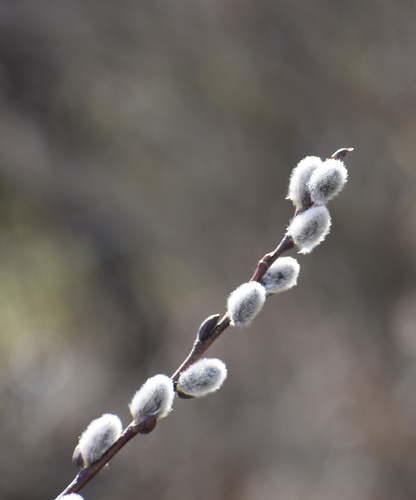
pussy willow
Salix discolor
The American pussy willow is the ultimate sign that winter is losing its grip. Its velvety catkins provide a critical early-season feast for bees and a stunning focal point for any backyard nature photographer.
Quick Identification
Size
A multi-stemmed shrub or small tree typically reaching 6–25 feet (2–7.5 meters) in height with a spread of 4–15 feet (1.2–4.5 meters).
Colors
Silvery-gray fuzzy male catkins; yellowish-green female catkins; dark green leaves with pale, glaucous (bluish-white) undersides; reddish-brown or purple winter twigs.
Key Features
- Soft, silky, fur-like male catkins appearing in late winter before leaves
- Leaves are alternate, elliptical, and glaucous underneath
- Typically grows as a multi-stemmed shrub in damp soil
- Bark is smooth and gray-brown, becoming fissured with age.
When You’ll See Them
Behavior
The American pussy willow is one of the most iconic heralds of spring in North America. Unlike many other trees, it is dioecious, meaning individual plants are either male or female. The famous 'pussy paws' are actually the male catkins (flower clusters) just before they fully bloom into yellow, pollen-covered spikes. This early blooming strategy makes them a vital 'first-food' source for emerging queen bumblebees and other early-season pollinators when little else is in flower.
In the backyard ecosystem, this willow acts as a powerhouse for biodiversity. It is a primary host plant for several butterfly species, including the Mourning Cloak and Viceroy, whose larvae feed on the foliage. While it grows vigorously in the spring and summer, it spends the winter in a dormant state, protected by dark, cap-like scales that drop off to reveal the fuzzy catkins as soon as the first thaws occur.
EverydayEarth exclusive
Camera Tips
Capturing the pussy willow is a unique challenge because the most interesting 'action' is either extremely slow (the blooming process) or extremely fast (the visiting pollinators). To document the iconic catkin transition, set up your camera on a sturdy tripod for a long-term time-lapse. Aim for one photo every 4 to 6 hours starting in late winter. This will capture the dramatic moment the dark bud scales drop and the silvery fur expands.
If you are using a motion-activated trail camera to catch wildlife visiting the willow, focus on the 'pollinator window.' Position your camera within 2-3 feet of a cluster of male catkins. Use a 'macro' or 'close-focus' setting if your camera supports it. Because early spring bees move quickly, set your camera to 'Burst Mode' or 'Photo + Video' to ensure you catch the insects as they dive into the pollen. High shutter speeds are essential here to avoid motion blur from vibrating wings.
For those interested in larger backyard visitors, place the camera at a lower height (2-3 feet) and angled slightly upward. Deer and rabbits frequently forage on the nutrient-rich buds and tender bark during the lean winter months. Since the white-gray catkins reflect light intensely, you may need to adjust your exposure compensation down (-1.0) if your camera allows it, or place the camera so it is not in direct midday sun to avoid 'blowing out' the details of the fuzz.
Don't overlook the night! While the plant doesn't move, many species of nocturnal moths are attracted to the nectar of the blooming catkins. Using a camera with a high-quality infrared flash will allow you to see these hidden pollinators without scaring them off. Ensure your camera is secured to a post or a heavy stake rather than a thin branch of the willow itself, as wind-sway in the willow's flexible branches will trigger false PIR detections.
Similar Species
Species that look similar or are commonly confused with pussy willow.
Frequently Asked Questions
Record pussy willow at your habitat
Connect a camera to start building your own species record — AI identifies every visitor automatically.