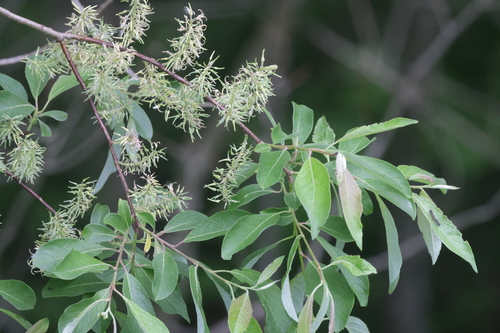
bebb's willow
Salix bebbiana
The ultimate wildlife 'grocery store' of the North, Bebb's willow is a hardy, beaked-fruit shrub that anchors backyard ecosystems from Alaska to New England.
Quick Identification
Size
4 to 10 metres (13 to 33 feet) in height; trunk diameter typically 10 to 20 cm (4 to 8 inches)
Colors
Dull green upper leaf surfaces with grayish-white downy undersides; reddish-brown to orange-brown twigs; bark is gray and becomes diamond-furrowed with age
Key Features
- Distinctive long-beaked fruit capsules on female catkins
- Elliptic to teardrop-shaped leaves with prominent net-like veins
- Diamond-shaped indentations on the bark of older stems
- Densely branched, multi-stemmed growth habit
When You’ll See Them
Geographic range
Where Does the bebb's willow Live?
Native to the vast northern reaches of North America, Bebb's willow is the most widely distributed willow on the continent. Its range stretches from the subarctic forests of Alaska and across every province of Canada to the Atlantic coast. In the United States, it thrives throughout the northern tier, extending down the Rocky Mountains into California, Arizona, and New Mexico, and across the Midwest into New England.
Basemap © OpenStreetMap contributors
Behavior
Bebb's willow is a resilient, fast-growing pioneer species that plays a vital role in stabilizing soil and reclaiming disturbed landscapes. Unlike some willows that require constant standing water, this species is relatively drought-tolerant and can thrive in a variety of moisture levels. It is one of the first plants to bloom in the spring, providing a critical early-season nectar source for emerging pollinators like bumblebees and early butterflies.
Ecologically, this willow acts as a foundational 'grocery store' for backyard and woodland wildlife. Its dense, twiggy structure offers excellent nesting cover for songbirds, while its foliage and bark serve as a primary food source for large mammals. It is well-known for its 'diamond willow' wood, where fungi cause the tree to create beautiful diamond-shaped depressions around suppressed branch stubs, making it a favorite for woodworkers and nature enthusiasts alike.
EverydayEarth exclusive
Camera Tips
When using an AI-powered camera to capture the life surrounding a Bebb's willow, the tree itself serves as your 'anchor' for wildlife activity. Position your camera approximately 5 to 10 feet away from the main cluster of stems, aiming at chest height. This allows you to capture large browsers like deer or moose that frequently nibble on the nutrient-rich twigs during the winter months. Use a wide-angle lens if possible to encompass the entire shrub, as animals will often move through the dense branches rather than standing in front of them.
For those interested in bird activity, place your camera focus on the middle section of the willow where the branching is densest. Bebb's willow is a preferred nesting site for yellow warblers and catbirds. Setting your camera to a 'fast-shutter' or 'burst mode' is essential here, as songbirds move quickly between the leaves. During the spring bloom, try a macro-attachment or a close-up setting to document the diverse array of native bees and flies that visit the catkins; these early pollinators are often the first signs of life on your camera after winter.
Don't neglect the winter season. Because Bebb's willow retains its structure and provides 'browse' (edible twigs), it is a hotspot for tracks and nighttime activity when other food sources are buried under snow. If your camera has high-quality infrared (IR) capabilities, point it toward the base of the willow to catch snowshoe hares or grouse seeking shelter. Avoid using heavy scent lures directly on the tree, as the natural willow bark contains salicin, which is already a significant attractant for many herbivores.
Similar Species
Species that look similar or are commonly confused with bebb's willow.
Pussy Willow
Pussy willow has larger, silkier catkins that appear earlier in spring and lacks the long-tapered 'beaks' on its seed capsules.
Scouler's Willow
Scouler's willow leaves are usually broader at the tip (obovate) compared to the more elliptic shape of Bebb's willow.
Grey Willow
An invasive European species with similar fuzzy leaves, but its buds are typically smaller and the inner bark shows distinct ridges when peeled.
Frequently Asked Questions
Record bebb's willow at your habitat
Connect a camera to start building your own species record — AI identifies every visitor automatically.