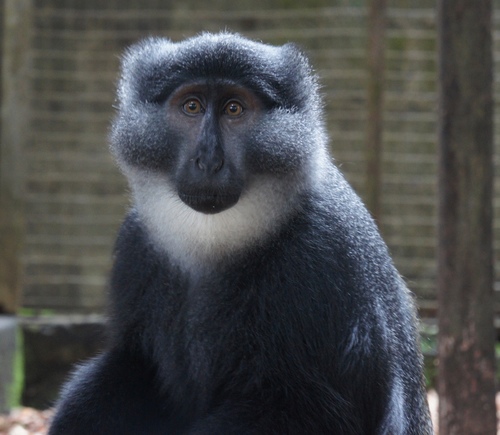
Preuss's Monkey
Allochrocebus preussi
A shadowy ghost of the high-altitude forests, the Preuss's Monkey is one of Africa's most elusive primates, distinguished by its striking white collar and terrestrial lifestyle.
Quick Identification
Size
Weight: 4–10 kg (8.8–22 lbs); Body length: 45–70 cm (18–28 in); Tail: 48–80 cm (19–31 in).
Colors
Deep charcoal-grey to blackish body fur; prominent white beard and throat ruff; subtle reddish-brown patch on the lower back.
Key Features
- Bright white 'bib' or beard wrapping around the throat
- Dark, grizzled grey-black coat with a subtle chestnut saddle
- Tail often held in a 'question mark' shape or downward hook
- Long limbs adapted for walking on the ground
When You’ll See Them
Behavior
Preuss’s Monkeys are fascinating primates that break the typical 'arboreal' mold of most guenons. They are semi-terrestrial, meaning they spend a significant portion of their day foraging and traveling on the forest floor rather than high in the canopy. They live in small, cohesive social groups usually led by a single dominant male and several females with their offspring, typically numbering between 2 and 12 individuals.
In the wild, they are notoriously shy and alert. They use the dense undergrowth of montane forests for cover, communicating with a variety of soft chirps and loud alarm calls to warn the group of predators like leopards or eagles. When threatened, they are more likely to flee on foot through the thick brush than to leap through the treetops. Because they inhabit specific high-altitude ranges in Western Africa, they are rarely seen by casual observers, making them a high-value species for wildlife researchers and camera trappers.
EverydayEarth exclusive
Camera Tips
Capturing the Preuss's Monkey on camera requires a strategy tailored to their terrestrial nature. Unlike many monkeys that stay high in the canopy, these primates travel on the ground. Position your camera significantly lower than usual—about 18 to 24 inches off the ground. Aim the lens across a known animal trail or a 'choke point' in the forest undergrowth where the vegetation is slightly thinner. This 'low-and-parallel' angle provides the best chance of capturing their distinctive white bib and facial features clearly.
Lighting is a major challenge in the dense montane forests where these monkeys live. The forest floor can be quite dark even at noon. To avoid blurry shots, use a camera with a high-speed trigger and a fast recovery time. If your camera allows, set the shutter speed higher or use 'High Quality' video settings to ensure the dark fur doesn't blend into the shadows. Infrared flash is essential, as it is less likely to spook these shy primates than a standard white flash, which might cause them to avoid the area in the future.
Since Preuss's Monkeys travel in social groups, avoid setting your camera to take only a single photo per trigger. Use 'Burst Mode' (3-5 photos) or, ideally, 20-30 second video clips. Often, a scout or the dominant male will pass by first, followed minutes later by the rest of the family. A video clip ensures you capture the full social dynamic and the younger monkeys who may be trailing behind the adults.
Scent control is often overlooked but vital for sensitive primates. When setting up your camera, wear gloves and try to minimize your time at the site. While they aren't as scent-focused as canines, Preuss's Monkeys have excellent eyesight and are highly attuned to changes in their environment. If they associate your camera site with human presence, they may alter their route. Check your camera during the middle of the day when they are less active to minimize the chance of a direct encounter.
Similar Species
Species that look similar or are commonly confused with Preuss's Monkey.
Frequently Asked Questions
Record Preuss's Monkey at your habitat
Connect a camera to start building your own species record — AI identifies every visitor automatically.