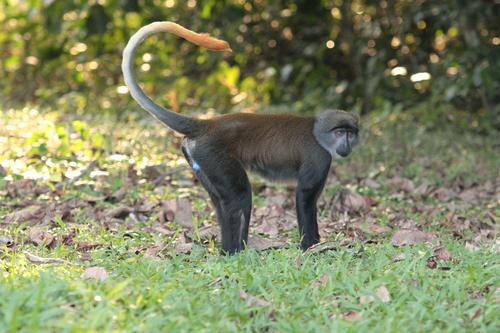
Sun-tailed Monkey
Allochrocebus solatus
The Sun-tailed Monkey is a hidden gem of the Gabonese rainforest, sporting a brilliant golden tail that glows against the forest floor. Discovered only in 1988, this shy and peaceful primate remains one of the most rewarding sightings for any wildlife enthusiast.
Quick Identification
Size
Body length 50-65 cm (20-25 in); tail length 60-75 cm (24-30 in); Weight 4-9 kg (9-20 lbs)
Colors
Dark charcoal or grizzled grey body; distinctive white ruff around the neck and throat; the distal half of the tail is a brilliant, fiery orange or golden-yellow.
Key Features
- Bright orange or golden-yellow tail tip
- Prominent white facial ruff and throat whiskers
- Dark grizzled charcoal body fur
- Stocky, semi-terrestrial build
When You’ll See Them
Behavior
Sun-tailed Monkeys are one of the most elusive and recently discovered primates in Africa. Primarily terrestrial, they spend a significant portion of their lives on the forest floor, moving with a quiet and cautious grace through the dense undergrowth. Unlike many of their more boisterous guenon cousins, these monkeys are relatively quiet and rely on the thick shadows of the Gabonese rainforest for protection.
Socially, they live in 'harem' groups consisting of a single dominant male and several females with their young. They are notably more peaceful within their social circles than other primates, showing high levels of tolerance toward related individuals. While they are sensitive to heavy human presence, they have shown a surprising ability to persist in forests that have undergone light, selective logging, provided the canopy remains largely intact.
EverydayEarth exclusive
Camera Tips
Capturing the Sun-tailed Monkey on camera requires a strategic approach focused on the forest floor rather than the canopy. Because these monkeys are semi-terrestrial, your camera should be mounted low—typically between 18 and 24 inches off the ground. Aim for clearings near large, fruiting trees where fallen fruit acts as a natural magnet. Look for 'monkey trails'—faint paths in the leaf litter—and position your camera to catch a side-profile view to showcase the iconic orange tail tip.
Lighting is your biggest challenge in their preferred dense, shady habitats. Use a camera with a high-quality infrared sensor to avoid scaring them with white light, as they are naturally shy. Since they travel in groups, set your camera to 'Burst Mode' or take 20-30 second videos. This ensures that even if the lead male passes by quickly, you'll capture the females and juveniles following behind. A fast trigger speed (under 0.3 seconds) is essential, as they can be surprisingly quick when crossing open gaps.
Seasonally, focus your efforts during the transition between the rainy and dry seasons when specific forest fruits ripen. In Gabon's humid environment, ensure your camera housing is equipped with fresh desiccant silica gel packs to prevent lens fogging. Avoid placing cameras in direct sunlight, which can cause 'false triggers' and wash out the subtle grey-and-black patterns of their fur. Positioning the lens facing North or South will help maintain consistent exposure throughout the day.
Similar Species
Species that look similar or are commonly confused with Sun-tailed Monkey.
Frequently Asked Questions
Record Sun-tailed Monkey at your habitat
Connect a camera to start building your own species record — AI identifies every visitor automatically.