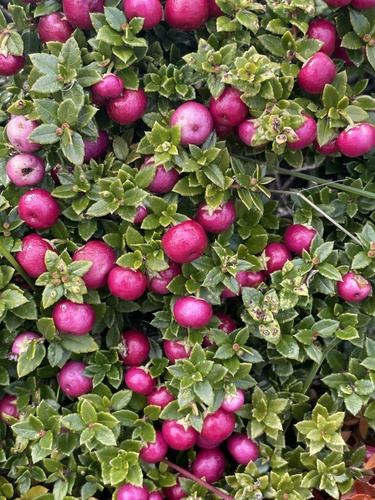
Prickly Heath
Gaultheria mucronata
A hardy survivor from the tip of South America, Prickly Heath is famous for its vibrant, marble-sized berries and needle-sharp leaves. This evergreen shrub is a cornerstone of Patagonian landscapes and a favorite sanctuary for backyard birds.
Quick Identification
Size
Height of 0.5–1.5 metres (1.6–5 feet) and a similar spread; berries are 1–1.5 cm (0.4–0.6 inches) in diameter
Colors
Glossy dark green foliage; waxy white or pale pink flowers; berries range from pure white to deep pink, crimson, and purple
Key Features
- Sharp, needle-tipped evergreen leaves
- Clusters of waxy, bell-shaped white flowers
- Large, marble-like berries in vibrant pink, white, or red
- Dense, multi-stemmed suckering growth habit
When You’ll See Them
Geographic range
Where Does the Prickly Heath Live?
Prickly Heath is native to the southern reaches of South America, specifically the Patagonian regions of Chile and Argentina down to Tierra del Fuego. It thrives in the cool, damp climates of the Valdivian temperate rainforests and southern alpine zones. Due to its hardiness and ornamental appeal, it has been widely introduced and naturalized in the United Kingdom, Ireland, and parts of the Pacific Northwest in North America, where it enjoys similar maritime conditions.
Basemap © OpenStreetMap contributors
Behavior
In the wild, this plant forms dense, impenetrable thickets thanks to its underground runners. These 'prickly' colonies provide excellent nesting sites and protective cover for ground-dwelling birds and small mammals, shielding them from larger predators. For humans, it is a low-maintenance landscape favorite that offers year-round visual interest while demanding very little in return beyond acidic soil and moisture.
EverydayEarth exclusive
Camera Tips
When setting up an AI-powered camera to capture Prickly Heath, your primary goal is to document the wildlife it attracts. Position your camera on a short tripod or a low ground-mount, aiming directly at a cluster of berries on a female plant. Since the shrub is low-growing, a lens height of 12 to 24 inches is ideal for capturing visiting thrushes, waxwings, and small rodents that treat the berries as a winter buffet.
For the best visual results, use a camera with a high-trigger speed and a 'Macro' or close-focus setting. The berries are the star of the show; capturing them in the early morning light when they are covered in frost or dew creates stunning, high-contrast images against the dark green, glossy leaves. Because the plant is evergreen and the berries persist through winter, this is an excellent subject for year-round monitoring in cold climates where other wildlife activity might slow down.
If you are looking to capture the plant's growth, use a time-lapse setting configured to take one photo every 24 hours. Over a few months, this will beautifully illustrate the transition from the delicate, waxy bell-shaped flowers of spring to the swelling, colorful fruits of autumn. To avoid false triggers from the 'prickly' leaves blowing in the wind, ensure your camera's PIR sensitivity is adjusted to ignore slight branch movements while still detecting the heat signatures of visiting animals.
Similar Species
Species that look similar or are commonly confused with Prickly Heath.
Frequently Asked Questions
Record Prickly Heath at your habitat
Connect a camera to start building your own species record — AI identifies every visitor automatically.